✧ The Art Vault: Public-Domain Celestial Engravings, Free to Browse
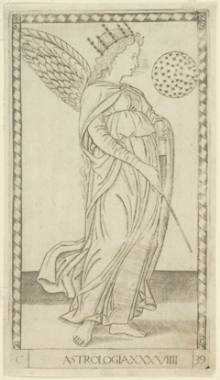
MODERNA modern technique: twentieth-century astrology.
954 public-domain astronomical and astrological engravings (celestial atlases, astrolabes, armillary spheres and zodiac plates) each credited to the museum that holds it, with a link to its own record. Nothing here was generated. Free, no account.
- What you'll needNothing at all
- What you getA browsable, searchable library of historical celestial art with full provenance, changing order daily
- CostFree, no account required
Runs in your browser.
4420+ people cast their chart here in the last 30 days.
What it is
Umbriel harvested 1,911 artworks from five open-access collections and kept the ones whose own catalogue entries say they are celestial. The vault ships 954 of them: Andreas Cellarius, Johann Bayer's Uranometria, Doppelmayr, Alexander Jamieson, Petrus Apianus, al-Biruni's lunar-phase diagrams, astrolabes and armillary spheres.
Every plate carries its maker, date, collection and licence, and links to the museum's own record so the credit can be checked. That is not a legal footnote. It is the difference between a museum object and a stock image, and it is the reason this is worth browsing at all.
Nothing in the vault is AI-generated. Worth saying plainly on a wall of pictures. Every one is a real object in a real collection, photographed by that institution and released into the public domain or under CC0.
The sources are the Wellcome Collection, the Art Institute of Chicago, the Cleveland Museum of Art, the Metropolitan Museum of Art and Wikimedia Commons, chosen because each publishes an unambiguous open-access designation rather than merely being old.
The order changes every day and holds still within a day, so the vault is different each time you open it without a picture vanishing while you are showing somebody.
How Umbriel computes it
The collection was assembled from five open-access museum APIs and then filtered on subject, which is the step that matters: museum search engines RANK results, they do not FILTER them, so a query for 'comet' returns a war club as its four-hundredth-best guess and every query returns something. Judging a record by the query that surfaced it would therefore pass everything. Each item is instead scored on what the institution's own catalogue says the object IS (its title, description, classification, medium and culture) never on the search term, giving 1,430 keeps, 341 too thin to call, and a small number cut outright. The shipped 954 are then chosen round-robin across subjects, not by score, because a straight ranking returns thirty-five Cellarius plates and ninety-six pages of one atlas: one book, over and over. Near-duplicate titles are collapsed for the same reason. Provenance travels with every image (maker, date, collection, accession, licence and a link to the source record) and is never separated from it. Credit fields are cleaned, not printed raw, because Wikimedia returns Wikidata qualifiers inside the date field and, worse, sometimes returns the file's UPLOAD timestamp there: uncorrected, that dated a sixteenth-century Petrus Apianus engraving to 2025. A confidently wrong date on a museum label is worse than no date, since the reader has no way to tell, so implausible dates are dropped, not shown. Display order is seeded on the calendar day, so the vault differs each day and holds still within one.
What's in your result
- 954 credited platesMaker, date, collection and licence on every one, with a link to the museum record.
- SearchableBy subject, maker or collection: zodiac, comet, astrolabe, Cellarius.
- A different order dailyRotated by date, so it changes but does not shuffle under you.
- Genuinely public domainFive open-access collections, each with an explicit CC0 or public-domain statement.
Common questions
Is the art in the vault free to use?
Every plate is in the public domain or released CC0 by the collection that holds it. Follow the link on any plate to that institution's own record for the exact statement, since the terms are theirs, not ours.
Where does the art come from?
The Wellcome Collection, the Art Institute of Chicago, the Cleveland Museum of Art, the Metropolitan Museum of Art and Wikimedia Commons.
Is any of it AI-generated?
No. Every item is a real object in a real collection, and each links to its own catalogue record.
What kind of art is in it?
Celestial atlases and star charts, zodiac plates, astronomical instruments (astrolabes, armillary spheres, orreries) planetary allegories and lunar-phase diagrams.
Do I need an account to browse the Art Vault?
No. It is free and needs nothing at all, not even a birth chart.
Go deeper
Each of these is a free tool in its own right.
Umbriel offers every system here as a set of prompts to think with, never as a statement of fact about who you are. Take what's useful, leave the rest.