The Earth is round
The Earth is round, says a Roman in 15 AD, and here is how he knows.
[p. 10] Well then, the Earth hangs midst the yielding AirNot stretcht into a Plain, but every whereIt rises and declines into a Sphere.In other Parts this Figure Nature drew,The Sun and Stars, if we exactly view,Seem round, the Moon is vary'd every Night,Nor with an equal Face receives her Brother's Light.This proves her round since different rays adorn,Now shape, now bend, now fill her borrow'd Horn.This Form's Eternal and may justly claimA Godlike Nature, all its parts the same;Alike and equal to its self 'tis found,No End's and no Beginning in a Round.Nought can molest its Being nought controul,And this enobles and confines the Whole.
[p. 11] First Argument
Hence every Countrey sees not every Sign,What Sailer views the bright ¹¹Canopus shineO'er Egypt's Shores, and when its Rays appearWho sees the little Circles of the Bear?For Earth still rising to a Round denies,A larger Scene, and bounds our feeble Eyes.
Second Argument
This Truth the ¹²Moon confirms when deep in NightEarth interposes, and diverts her Light,She doth not all the World at once surprize,But now seems dark to these, now other Eyes.The Eastern Parts first view her darkned Face,Then o'er the South she rolls her broken Rays;And then still prest by the obscuring shade,She hears the Western Brass resounding to her Aid.
Now if the Earth were flat the darkned MoonWould seem to all Eclypst as well as one.At once presenting to the common viewHer gloomy looks, and prove this fancy true.But since its Figure's round, dim Cynthia's beamsBy just degrees must visit the Extremes;Not all at once; she must divide the Skies,And while she sets to some, to others rise.For in the mighty Concave whirl'd aboveShe rising must, and must declining move;Now climb this rising, and her Glories show,Then sink again, and scatter Beams below.This proves (nor shall the subtlest Wits escapeThese twining Reasons) the disputed Shape.
By various Animals this Globe's possest,The Common House of Man, of Bird, and Beast;The Northern ¹³parts rise high, the Southern fallBeneath our Fee, the Adverse of the Ball.Yet as it lies its surface seems a Flat,Though false, its bigness doth improve the Cheat,And take the Roundness off, though every whereIt riseth and declines into a Sphere.Hence when with setting Beams the Sun withdrawnBeholds our East, they see the Morning dawn;And when their Toils He with his Light restores,Sleep sits on Us, and gently easeth Ours.
The notes
¹¹ Canopus is a Star in the Southern Keel of the Ship Argo, of the first magnitude: These particulars as to the Appearance of the two Stars are not mathematically true, yet serve well enough for the Poets design, sufficiently proving the roundness of the Earth. (Creech’s note, 1697)
¹² This Argument being taken from the Eclipse and not from the increase or decrease of the Moon, the Poet must be understood, not as to divers moments of Time, for the Moon at the same instant is seen Eclips'd by all to whom she appears above the Horizon, but as to the diversity of Hours at which the Eastern or Western People reckon the Eclipse to begin or end. (Creech’s note, 1697)
¹³ This is to be understood in respect of those who inhabit the Northern Hemisphere, to whom the North Pole is still elevated. (Creech’s note, 1697)
In the app the old words open a note in the margin when you tap them, the old books read the planets of your own chart, and each book opens where you left it. Free, no account, no email.
14160+ people cast their chart here in the last 30 days.
Keep reading
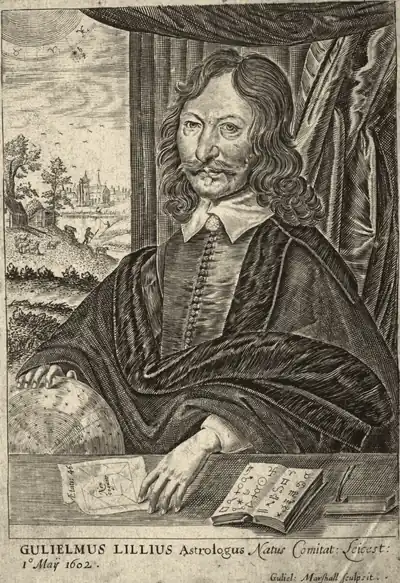
The text is Thomas Creech's 1697 verse translation, checked word by word between three scans of the same type (the 1697 printing, the 1700 printing and a third copy). The long s is printed as s; every other spelling is Creech's. Pages are cited as the 1697 printing numbers them. The portrait is William Marshall’s engraving of Lilly from the front of the 1659 printing (Wellcome Library, public domain).