Trines
Trines: three signs joined in a triangle, and the friendship between them.
[p. 60] From Aries rightways draw a Line, to endIn the same Round, and let that Line subtendAn equal Triangle; now since the LinesMust three times touch the Round, and meet three Signs,Where e're they meet in Angles those are ¹⁷Trines.Because they are at equal distance seenOn either side; and leave three Signs between.Thus Aries sees on either side belowThe Lion roar, and Centaur draw his Bow:The Bull with Caper and the Maid are foundIn Trine: Thus fix the others of the Round.Signs Left and ¹⁸Right are in the Trines agreed,The Left still follow, and the Right precede;The Maid is Left, and Caper to the BullIs Right: Thus fix the others by this Rule.
The notes
¹⁷ Suppose in the Zodiack Circle Twelve Signs, and in every Circle 360 Parts or Degrees, and 30 of these Degrees to belong to each of the Twelve Signs. Begin at any of the Signs, for instance, Aries; and in this Circle inscribe a Triangle, all whose sides are equal; it is evident that the Arch of the Circle which each of these sides subtends, contains 120 Parts or Degrees; and therefore between that Sign from which you begin to draw each side of this Triangle, and that to which you draw it, there must be Three Signs. But see Fig. 1st. (Creech’s note, 1697)
¹⁸ To shew what Signs are to be accounted Right, and what Left, the Poet mentions only the Trine of Taurus: Yet it is sufficient, upon View of Fig. 1st. direction for all the rest. (Creech’s note, 1697)
In the app the old words open a note in the margin when you tap them, the old books read the planets of your own chart, and each book opens where you left it. Free, no account, no email.
14160+ people cast their chart here in the last 30 days.
Keep reading
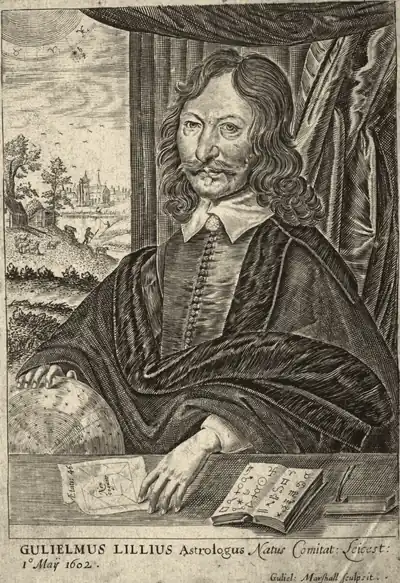
The text is Thomas Creech's 1697 verse translation, checked word by word between three scans of the same type (the 1697 printing, the 1700 printing and a third copy). The long s is printed as s; every other spelling is Creech's. Pages are cited as the 1697 printing numbers them. The portrait is William Marshall’s engraving of Lilly from the front of the 1659 printing (Wellcome Library, public domain).