The first Argument for Fate
Creech's summary of Book IV, then why worry, when everything is fated? The first proof: Rome's history.
[p. 1] The Argument
After a short Reflection on the vain Cares of Mankind, he brings several Arguments to prove Fate: 1. Several unaccountable passages in the Roman and Grecian Histories: 2. Sudden Death, and unexpected Recoveries, contrary to all the powers of Art and Physick: 3. The difference between the Children of the same Parents: 4. The fewness of Worthy Men, and the certainty of Death: 5. The ill successes of Wise and Good Men, and the prosperity of Knaves and Fools: 6. Monstrous Births: 7. Prophesy: And then endeavours, 8. to take off some Objections that might be rationally brought against this Doctrin: Then, 9. He shews what Tempers and Inclinations the twelve Signs singly consider'd do bestow; and to what Arts they incline: 10. Vnder the Ram, are born all sorts of workers in Wool, Broakers, Men of unsetled Fortunes, fearful, inconstant, and covetous of Praise: 11. Vnder the Bull, Plowmen, Aspiring, Reserv'd, Strong, and Amorous: 12. Vnder the Twins, Musicians, Songsters, Men of merry Tempers, and Astronomers: 13. Vnder the Crab, Covetous Fellows and Vsurers: 14. Vnder the Lion, Hunters, Beast-keepers, Plain, Open-hearted, easily provok'd, and easily appeas'd: Vnder the Maid, Philosophers, Orators, Notaries, shamefac'd and indifferently good: 16. Vnder the Scales Measurers, Gagers, Accountants, Lawgivers, Lawyers, and Judges: 17. Vnder the Scorpion, Hunters, Gladiators, Men of Warlike and Military Dispositions: 18. Vnder Sagittarius, Chariot-Racers, Horse-breakers, Tamers of Wild Beasts, Men of acute Vnderstandings, and strong and nimble Bodies: 19. Vnder the Goat, Miners, Coyners, Goldsmiths, Bakers, Broakers, Inconstant and Lascivious in their Youth: 20. Vnder Aquarius, Men skill'd in making Aqueducts, and Water-works, and Spheres, and Globes, tractable and prodigal: 21. Vnder Pisces, Mariners, Pilots, Shipwrights, Rowers, Fishers, Fruitful but Inconstant: 22. He Discourses of the Tenths of each Sign, and what Sign is Lord of each third part of every Sign: 23. He encourages his Scholar to go on, tho' the Task seems to grow upon him, and to be very difficult, because 'tis a Noble Study, and the Object truly great: 24. He shews what degrees of each Sign are hurtful, what not: 25. He Teaches, that the Tempers of those that are Born when the Sign riseth, are different from those that are Born at other times: 26. He draws a Map of the Earth and Seas, and Teaches what Signs govern particular Countries: 27. He shews what Signs are call'd Eccliptick, and why: 28. He proposeth such Objections as are made to deter Men from this curious search, and answereth them.
[p. 3] Short Reflections on worldly Cares
Why should our Time run out in useless years,Of anxious Troubles and tormenting Fears?Why should deluding Hopes disturb our ease;Vain to pursue, yet eager to possess?With no Success, and no Advantage crown'd,Why should we still tread on th' unfinisht Round?Grown gray in Cares, pursue the senseless strife,And seeking how to Live, consume a Life?The more we have, the meaner is our Store;The unenjoying craving Wretch is Poor:But Heaven is kind, with bounteous Hand it grantsA fit supply for Nature's sober wants:She asks not much, yet Men press blindly on,And heap up more, to be the more undone:By Luxury, they Rapine's Force maintain,What that scrapes up, flows out in Luxury again;And to be squander'd, or to raise debate,Is the great only use of an Estate.
[p. 4] Vain Man forbear, of Cares, unload thy Mind,Forget thy Hopes, and give thy Fears to Wind;For Fate rules all, its stubborn Laws must swayThe lower World, and Man confin'd obey;As we are Born we Dye, our Lots are cast,And our first Hour disposeth of our last.Then as the influence of the Stars ordains,To Empires Kings are doom'd, and Slaves to Chains.Then Poverty, that common Fate comes down,(Few Stars are Regal, and design a Crown)What make a Wit, a Knave, a Saint, or Dunce,Are hudled then together, and fixt at once.The Ills that are ordain'd we must endure,From not Decreed how fatally secure?Prayers are too weak to check fixt Destinies,And Vows too slow to catch the Fate that flies.Whether with Glory rais'd, or clogg'd with Scorn,The State, that then is setled, must be born.
For did not Fate preside, and Fortune lead,Had parting Flames the good ¹Aeneas fled?Had Troy's sunk Fortune been sustain'd by ²one?And only Conquer'd then, when overthrown?And did not Stars the rise of States dispose,Had mighty Rome from such beginnings rose?Had ³Shepherds built, or Swains without controulAdvanc'd their ⁴Cottage to a Capitol?Plac'd on whose heights, our Caesars now surveyThe lower Earth, and see the World obey?From their ⁵burnt Nest, had Conquering Eagles flown,And the World yielded to a ruin'd Town?
[p. 5] Had Jove been storm'd; or ⁶Mutius safe return'dFrom baffled Flames, or vanquish'd whilst he burn'd?Our Towns and Bridges guard, had ⁶Cocles stood,Or the weak ⁶Virgin swam rough Tiber's Flood?Had one ⁶Horatius our sunk hopes restor'd,Or Three have fall'n beneath a single Sword?O Glorious Victory! what Arms before,E're won so much, none ever fought for more;Rome and her hopes of Empire hung on One,His o're matcht Lot was Hers, a Yoke or Throne,
Why should I ⁸Cannae's bloody Plains relate,And Africk's Ensigns threatning at our Gate,How Thrasymene Drown'd Flaminius's Shame,And after Fabius, wise Retreats o'recame,The Conquer'd Carthage shone with Roman flame?How Hannibal on the Campanian Plains,Rome's Terror once, then destin'd to our Chains;Whilst waiting on his Proud Bithynian Lord,Stole a base Death, and scap't our Nobler Sword?But turn and view the ⁹Civil Wars of Rome,There opens wide a various Scene of Doom:See Marcus ride with Cimbrian Lawrels Crown'd,Then in the Dungeon stretcht upon the ground;Now Slave, now Consul, Consul, Slave again,His Curule Chair, succeeded by a Chain;Now a mean Ruin on the Lybian SandsDespis'd he lies, and streight the World Commands;Like Thunder from low Earth exhal'd, he roseFrom the Minturnian Pools,And scatter'd Vengeance on his haughty Foes.
[p. 6] These wondrous Changes Fate and Stars advance,O mighty turns, and much too great for Chance!Who ¹⁰Pompey could (that saw thy Conquering FleetRegain the Seas, and Kings beneath thy Feet,Proud Pontus yield, fierce Tyrants make thy Train,And crowding Monarchs beg thy leave to Reign,That saw Victorious Lawrels Crown thy Head,And Worlds in thy repeated Triumphs lead;And all that Glory which thy Sword had won,Fixt and supported by as great a ¹¹Son)Have thought that Thou, upon a Foreign Sand,Should'st steal a Burial from a common Hand;That shatter'd Planks, the Sea's dishonest spoilShould hiz beneath thy Trunk, and be thy Pile?That Thou, the mighty Thou, should'st want an Urn,What Power, but Fate, could work so strange a turn?
E'en ¹²Caesar sprung from Heaven, and now a Star,Tho' midst the dangers of the Civil War,Secure He stood, and careless of Repose,Was ne're surpriz'd by his most watchful Foes;Yet Crown'd with Peace, in all his Pomp and StateHe fell a Victim to o're-ruling Fate:No dark suspitions, but bright hints were brought,He knew what Cassius spoke, and Brutus thought;How far advanc'd, how far they meant to go,And saw the minute of the fatal Blow:Yet dark Oblivion did his Memory blot,He all his warnings, and Himself forgot;And in the Senate, whilst his Right Hand heldThe faithful Bill, which all the Plot reveal'd;To prove that Fate will sway, and Stars controul,He fell, and with his Blood defac'd the Scroul:O mighty power of Fate, and prov'd too well!The Best, the Wisest, and the Greatest fell.
[p. 7] Why should I mention Kings ¹³and Empires Falls,Shew Conquering ¹³Cyrus on the Sardian Walls?Or Craesus shrinking at the rising Flame?Or ¹³Priam's Trunk, a thing without a Name?Unhappy Prince! the Beasts and Vultur's spoil,His Troy was burnt, but Priam wants a Pile.The Wreck of ¹³Xerxes, who wou'd scourge the Gods,A Wreck, much greater than the threatned Floods?Or ¹³Tullus's Reign, who by the power of Fate,Was born a Slave, yet Rul'd the Roman State?Or shew ¹³Metellus snatch the Vestal Fire,And as he pass'd, prophaner Flames retire?
The notes
¹ The Poet did not think of the Palladium as Scaliger imagines, but only of the Fire at Troy, which parted to let Aeneas go through with his Father, and his Household Gods. (Creech’s note, 1697)
² Manilius makes only short Reflections on History, and therefore is frequently obscure: He says here, that it was impossible one single Aeneas should have rais'd the Glory and Reputation of ruin'd Troy, and made it then conquer, when it was overthrown, by building Rome which subdu'd the whole World; for Rome rose out of the Ruins of Troy; unless some over-ruling Power and Fate had ordain'd it should be so. (Creech’s note, 1697)
³ Romulus and Remus, the Founders of Rome, were but Shepherds. (Creech’s note, 1697)
⁴ I chuse to read Auxissent Culmina rather than vexissent, or duxissent Fulmina, and render Culmina Cottage. (Creech’s note, 1697)
⁵ If Manilius be suppos'd to keep the Order of Time in his Historical Reflections, I must own I have not hit his meaning in this place; for no doubt he had an Eye upon the Wars between the Sabines and Romulus, but then I cannot imagine what those Words Captus & a Captis Orbis foret mean: I cannot think with Scaliger and Huetius that he runs back to Troy, which he had left several Verses before, and therefore apply this passage to the taking and burning of Rome, and the besieging the Capitol by the Gauls: And 'tis certain the Poet in his following Reflections neglects the Order of Time very much. (Creech’s note, 1697)
⁶ The Stories of Mutius Scaevola, Horatius Cocles, the Virgin Clelia, and the Combat between the three Horatij on the Roman, and the three Curiatij on the Alban side, are well known. (Creech’s note, 1697)
⁸ Short Reflections on the great Accidents in the Second and Third Carthaginian Wars, together with the Death of Hannibal. (Creech’s note, 1697)
⁹ He goes on with the Roman History, the unaccountable Fortunes of the Great Marius. (Creech’s note, 1697)
¹⁰ Pompey the Great, was a very notable Example of the variety of Fortune, being on a sudden rais'd to the highest, and as soon thrown down to the lowest Condition in the World. (Creech’s note, 1697)
¹¹ Cum jam etiam posses alium cognoscere Magnum: I hope I have given this Verse a better Sense, than the other Interpreters have done. (Creech’s note, 1697)
¹² Caesar is said to be sprung from Heaven, because he was descended from Aeneas the Son of Venus: After his Murther an unusual Star appear'd, which the Flatterers of Augustus said was the Soul of his Father Caesar. (Creech’s note, 1697)
¹³ The Poet closeth his Examples with Reflections on the overthrow of Craesus, the Famous wealthy King of Lydia, who was taken by Cyrus; on the wretched Condition to which old Priam was reduc't; on the unaccountable overthrow of Xerxes; on the Advancement of Servius Tullus, who was the Son of a Bond-Woman, and yet came to be King of Rome, and on the Conduct of Metellus, who broke into the Temple of Vesta when it was on Fire, and brought out the Image of the Goddess. (Creech’s note, 1697)
In the app the old words open a note in the margin when you tap them, the old books read the planets of your own chart, and each book opens where you left it. Free, no account, no email.
14160+ people cast their chart here in the last 30 days.
Keep reading
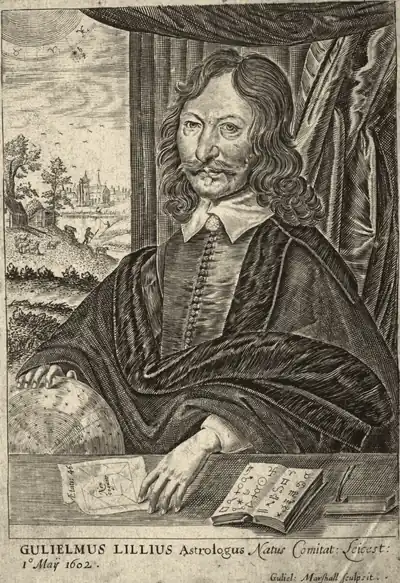
The text is Thomas Creech's 1697 verse translation, checked word by word between three scans of the same type (the 1697 printing, the 1700 printing and a third copy). The long s is printed as s; every other spelling is Creech's. Pages are cited as the 1697 printing numbers them. The portrait is William Marshall’s engraving of Lilly from the front of the 1659 printing (Wellcome Library, public domain).