The Ship
The Ship rises with Aries: born sailors and pilots.
[p. 56] What Constellations rise with Aries
First Golden Aries Shines, (who whilst he swamLost part of's Freight, and gave the Sea a Name:Whose ²Skin destroy'd himself, whose Golden SpoylForc't fierce Medea, from her Native Soyl;Then Magick Arts to Cholchis Shores confin'dFirst Sail'd abroad, and Poyson swell'd the Wind:)And now as Victor o're the Conquer'd DeepHe keeps his Power, and still Commands the Ship:For when the ³Northern Rudder rears its Flame,And in the fourth Degree, first joyns the Ram:Who ever's born, shall be to Sail inclin'd,He'll Plow the Ocean, and he'll tempt the Wind:He o're the Seas shall Love, or Fame pursue;And other Months, another ⁴Phasis view:Fixt to the Rudder, he shall boldly Steer,And pass those Rocks which ⁵Tiphys us'd to fear.
[p. 57] Had no such Births been born Troy's Walls had stood,No ⁶Wind-bound Navy, bought a Gale with Blood;No ⁷Xerxes Persia o're the Ocean roul'd,Dug a new Sea, nor yet confin'd an old.No Athens sunk by ⁸Syracusian Shores,Nor Lybia's Seas been choakt with Punick Oars,Nor had the World in doubt at Actium stood,Nor ⁹Heaven's great Fortune floated on the Flood:Such Births as these their hopes to Seas resign,Ships spread their Sails, and distant Nations joyn,The World divided, mutual Wants inviteTo close again; and Friendly Ships unite.
The notes
² The Ram having a Golden Fleece, as the Poets fancy'd, the King of Colcos kill'd him that he might enjoy the Treasure, and Jason being sent to fetch this Golden Fleece carried away Medea the King's Daughter. (Creech’s note, 1697)
³ The Ship hath two Rudders, a Northern, and a Southern Rudder. (Creech’s note, 1697)
⁴ A River of Colchos, whither Jason with the Argonauts first Sailed. (Creech’s note, 1697)
⁵ Typhis, the Pilot to the Argonauts, who in his Voyage steer'd thro' the dangerous moving Rocks called the Symplegade. (Creech’s note, 1697)
⁶ The Grecian Navy lay Wind-bound till Iphigenia was Sacrificed, and appeased the anger of Diana. (Creech’s note, 1697)
⁷ Vossius, in his Observations on Catullus, Reads—— Invehet undis Persida The Expression is bold, and therefore proper for the Poet. That Xerxes dug a new Channel, and made a Bridge over the Hellespont, are known stories. (Creech’s note, 1697)
⁸ Manilius mentions several notable defeats at Sea, such was that of the Athenians near Syracuse, which brought the Athenians very low: such were those of the Carthaginians by the Romans; And that of Antony by Augustus near Actium. (Creech’s note, 1697)
⁹ Heavens great Fortune: Because the Conquerour was to be deify'd. (Creech’s note, 1697)
Old words on this page
- native
- the person whose birth chart it is.
In the app the old words open a note in the margin when you tap them, the old books read the planets of your own chart, and each book opens where you left it. Free, no account, no email.
14160+ people cast their chart here in the last 30 days.
Keep reading
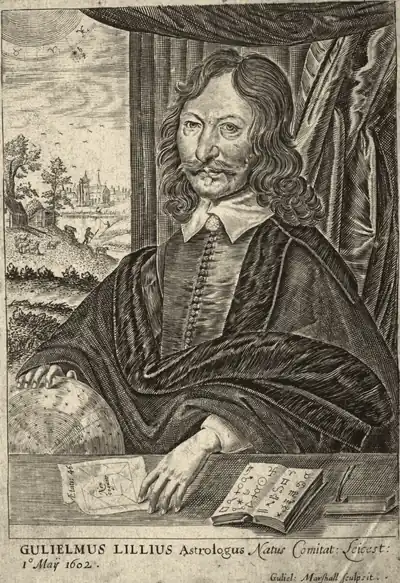
The text is Thomas Creech's 1697 verse translation, checked word by word between three scans of the same type (the 1697 printing, the 1700 printing and a third copy). The long s is printed as s; every other spelling is Creech's. Pages are cited as the 1697 printing numbers them. The portrait is William Marshall’s engraving of Lilly from the front of the 1659 printing (Wellcome Library, public domain).