Signs beholding each other, and of equal Power
Signs that look at each other as equals.
[p. 39] Any two signs, equally distant from either tropical sign, are equal to each other in power; because the Sun, when present in one, makes day and night, and the divisions of time, respectively equal in duration to those which he produces when present in the other. Such signs are also said to behold each other, as well for the foregoing reasons, as because each of them rises from one and the same part of the horizon, and sets in one and the same part*.
The notes
* Whalley has a very lengthy note upon this and the preceding chapter, to shew that Ptolemy here speaks of zodiacal parallels, or parallels of declination, and to point out the necessity of observing a planet’s latitude, in order to ascertain its true parallels. It is, however, to be recollected, that the parallels now alluded to are distinct from the mundane parallels, which are equal distances from the horizon or meridian, and are considered by Ptolemy in the 14th and 15th Chapters of the 3d Book of this work;—although not under the express name of mundane parallels. (Ashmand’s note, 1822)
In the app the old words open a note in the margin when you tap them, the old books read the planets of your own chart, and each book opens where you left it. Free, no account, no email.
14160+ people cast their chart here in the last 30 days.
Keep reading
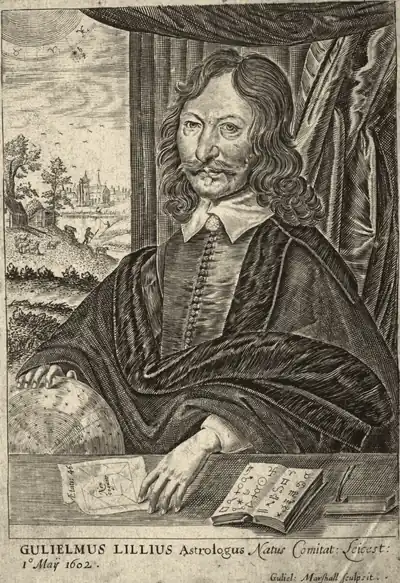
The text is J. M. Ashmand's 1822 translation, checked word by word between two scans of the 1822 printing (Wellcome Library and Harvard). Pages are cited as the 1822 printing numbers them. The portrait is William Marshall’s engraving of Lilly from the front of the 1659 printing (Wellcome Library, public domain).