The Triplicities
The four triplicities, fire, earth, air and water, and who rules each.
[p. 43] The familiarity existing by triplicity arises in the following mode:
The triplicity preserves accordance with an equilateral triangle, and the whole zodiacal orbit is defined by three circles, viz. that of the equinox, and those of the two tropics; the twelve signs are, therefore, distributed among four equilateral triangles.
[p. 44] The first triangle, or triplicity, is formed by three masculine signs, Aries, Leo, and Sagittarius, having the Sun, Jupiter, and Mars, as lords by house. Mars, however, being contrary in condition to the solar influence, this triplicity receives, as its lords, only Jupiter and the Sun. By day, therefore, the Sun claims the principal co-regency of it, and Jupiter by night. Aries is on the equinoctial circle, Leo on the summer, and Sagittarius on the winter circle. This triplicity is principally northern, owing to the concurrent dominion of Jupiter, who is fruitful and airy, and expressly connected with winds proceeding from the north; it is, however, also north-west, in consequence of being, in some degree, combined with the west by means of the house of Mars, who introduces western breezes and the feminine qualities of that quarter, in consequence of his lunar condition*.
The second triplicity, formed by Taurus, Virgo, and Capricorn, is allotted to the dominion of the Moon and Venus, since it consists of feminine signs. The Moon rules it by night, and Venus by day. Taurus is on the summer circle, Virgo on the equinoctial, and Capricorn on the winter. This triplicity is southern, in consequence of the dominion of Venus, whose warm and moist influence produces south winds: it, however, additionally receives a mixture of the east, by means of Saturn; for, as Capricorn is the house of that planet, and an eastern sign, Saturn becomes effective of winds from that quarter, and furnishes this triplicity with a mixture of the east, with which quarter he is further connected by means of his solar condition†.
The third triplicity is composed of Gemini, Libra, and Aquarius, masculine signs. It holds connection with Saturn and Mercury by containing their houses, and is therefore attributed to them, and not to Mars, to which planet it bears no relation. Saturn rules it by day, owing to his condition*, and Mercury by night. Gemini is on the summer circle, Libra on the equinoctial, and Aquarius on the winter. This triplicity is principally eastern, by the influence of Saturn; but it becomes north-east by receiving also a mixture of the north from the condition of Jupiter, with which planet Saturn has, in this respect, a diurnal familiarity†.
[p. 45] The fourth triplicity, formed by Cancer, Scorpio, and Pisces, is left to the remaining planet, Mars, who has right in it by means of his house, Scorpio. But, as the signs which compose this triplicity are feminine, the Moon by night and Venus by day, through their feminine condition, govern it, together with Mars. Cancer is on the summer circle, Scorpio on the winter, and Pisces on the equinoctial. This triplicity is western, in consequence of the government of the Moon and Mars; but it is also blended with the south by the joint dominion of Venus, and therefore becomes south-west.
The notes
* The “lunar condition” here spoken of refers to the position of Aries (Mars’s house) in the lunar semicircle. (Ashmand’s note, 1822)
† Capricorn being in the solar semicircle. (Ashmand’s note, 1822)
* The reason for making Saturn diurnal lord of this triplicity may be found in Chap. vii. (Ashmand’s note, 1822)
† This familiarity seems to arise from the sextile aspect between Aquarius, the diurnal house of Saturn, and Sagittarius, the diurnal house of Jupiter. (Ashmand’s note, 1822)
Old words on this page
- triplicity
- one of the four groups of three signs: fire, earth, air and water.
- viz
- short for videlicet, Latin for "namely".
- diurnal
- of the day. A diurnal planet or sign belongs to daytime.
In the app the old words open a note in the margin when you tap them, the old books read the planets of your own chart, and each book opens where you left it. Free, no account, no email.
14160+ people cast their chart here in the last 30 days.
Keep reading
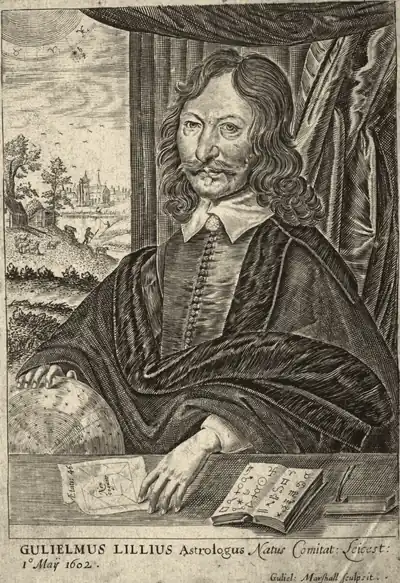
The text is J. M. Ashmand's 1822 translation, checked word by word between two scans of the 1822 printing (Wellcome Library and Harvard). Pages are cited as the 1822 printing numbers them. The portrait is William Marshall’s engraving of Lilly from the front of the 1659 printing (Wellcome Library, public domain).