The Places and Degrees of every Planet
The exact places and degrees each planet claims.
[p. 53] The signs have been subdivided by some persons into parts still more minute, which have been named places and degrees of dominion. Thus the twelfth part of a sign, or two degrees and a half, has been called a place, and the dominion of it given to the signs next succeeding. Other persons again, pursuing various modes of arrangement, attribute to each planet certain degrees, as being aboriginally connected with it, in a manner somewhat similar to the Chaldaic arrangement of the terms. But all these imaginary attributes cannot be herein detailed, for they receive no confirmation from nature, are not capable of being rationally demonstrated, and are, in fact, merely the offspring of scientific vanity.
[p. 54] The following observation, however, deserves attention, and must not be omitted.
The beginnings of the signs, and likewise those of the terms, are to be taken from the equinoctial and tropical points. This rule is not only clearly stated by writers on the subject, but is also especially evident by the demonstration constantly afforded, that their natures, influences, and familiarities, have no other origin than from the tropics and equinoxes, as has been already plainly shewn*. And, if other beginnings were allowed, it would either be necessary to exclude the natures of the signs from the theory of prognostication, or impossible to avoid error in then retaining and making use of them; as the regularity of their spaces and distances, upon which their influence depends, would then be invaded and broken in upon.
The notes
* Vide Chapters xii and xiv of this Book. (Ashmand’s note, 1822)
In the app the old words open a note in the margin when you tap them, the old books read the planets of your own chart, and each book opens where you left it. Free, no account, no email.
14160+ people cast their chart here in the last 30 days.
Keep reading
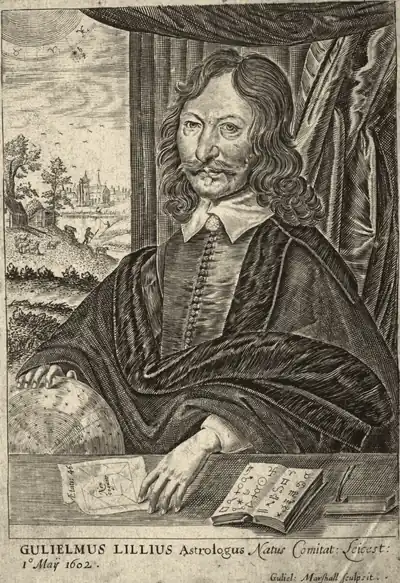
The text is J. M. Ashmand's 1822 translation, checked word by word between two scans of the 1822 printing (Wellcome Library and Harvard). Pages are cited as the 1822 printing numbers them. The portrait is William Marshall’s engraving of Lilly from the front of the 1659 printing (Wellcome Library, public domain).