The Influences of the Planetary Orbs
Each planet's temperature: who heats, who cools, who dries and who soaks. The root of everything after.
[p. 19] The Sun† is found to produce heat and moderate dryness. His magnitude, and the changes which he so evidently makes in the seasons, render his power more plainly perceptible than that of the other heavenly bodies; since his approach to the zenith of any part of the earth creates a greater degree of heat in that part, and proportionately disposes its inhabitants after his own nature.
[p. 20] The Moon principally generates moisture; her proximity to the earth renders her highly capable of exciting damp vapours, and of thus operating sensibly upon animal bodies by relaxation and putrefaction. She has, however, also a moderate share in the production of heat, in consequence of the illumination she receives from the Sun.
Saturn produces cold and dryness, for he is most remote both from the Sun’s heat and from the earth’s vapours. But he is more effective in the production of cold than of dryness. And he and the rest of the planets derive their energy from the positions which they hold with regard to the Sun and Moon; and they are all seen to alter the constitution of the Ambient in various ways.
Mars chiefly causes dryness, and is also strongly heating, by means of his own fiery nature, which is indicated by his colour, and in consequence of his vicinity to the Sun; the sphere of which is immediately below him.
Jupiter revolves in an intermediate sphere between the extreme cold of Saturn and the burning heat of Mars, and has consequently a temperate influence: he therefore at once promotes both warmth and moisture. But, owing to the spheres of Mars and the Sun, which lie beneath him, his warmth is predominant: and hence he produces fertilizing breezes.
To Venus also the same temperate quality belongs, although it exists conversely; since the heat she produces by her vicinity to the Sun is not so great as the moisture which she generates by the magnitude of her light, and by appropriating to herself the moist vapours of the earth, in the same manner that the Moon does.
[p. 21] Mercury sometimes produces dryness, and at other times moisture, and each with equal vigour. His faculty of absorbing moisture and creating dryness proceeds from his situation with regard to the Sun, from which he is at no time far distant in longitude; and, on the other hand, he produces moisture, because he borders upon the Moon’s sphere, which is nearest to the earth; and, being thus excited by the velocity of his motion with the Sun, he consequently operates rapid changes tending to produce alternately either quality.
The notes
† It will be recollected that the Ptolemaic hypothesis considers the Sun as a planetary orb, in consequence of his apparent progress through the zodiac. (Ashmand’s note, 1822)
In the app the old words open a note in the margin when you tap them, the old books read the planets of your own chart, and each book opens where you left it. Free, no account, no email.
14160+ people cast their chart here in the last 30 days.
Keep reading
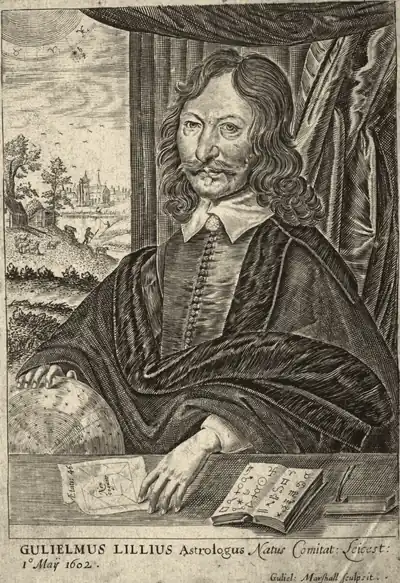
The text is J. M. Ashmand's 1822 translation, checked word by word between two scans of the 1822 printing (Wellcome Library and Harvard). Pages are cited as the 1822 printing numbers them. The portrait is William Marshall’s engraving of Lilly from the front of the 1659 printing (Wellcome Library, public domain).