Travelling
Long journeys, and whether you come home.
[p. 195] The circumstances indicative of travel are to be considered by means of the situation held by both the luminaries, in respect to the angles, and, especially, by means of that held by the Moon. For, should she be descending, or cadent from the angles, she will cause journies and changes of residence: Mars, also, if descending, or cadent from the zenith, will sometimes do the same, provided he may occupy a situation in quartile, or in opposition to the luminaries. And, if the part of Fortune, also, should happen to be placed in signs which produce travelling, the course and practice of the whole life will be engaged in foreign lands. And further, provided the benefics superintend the aforesaid places, or ascend in succession to them, the engagements abroad will be honourable and lucrative, and the return home speedy and unobstructed: but if, on the contrary, the malefics superintend or ascend in succession to those places, the journey outward will then lead to peril and misfortune, and the return will be replete with difficulty. But it is, at the same time, necessary in all cases to consider the contemperament also, and to observe such of the existing configurations as are more predominant.
It most usually happens, that, if the luminaries be posited in the cadent houses of the oriental quadrants, the travel will take place in the eastern or southern quarters of the world; and that, if placed in western situations, or in an occidental quadrant, travel will be then prosecuted in the northern or western parts. And, should the signs, which operate travel, be themselves single in form, or should the planets, having dominion of them, be singly posited, the journies will then take place after long intervals, and occasionally only: but, if the said signs be bicorporeal, or double in form or figure, travel will be constantly repeated and continued.
[p. 196] Thus, when Jupiter and Venus may be in dominion over the luminaries, and over the places producing travel, they will render the journies agreeable, as well as free from danger: for the traveller will be joyfully forwarded on his way by the magistrates of the country, and by the concurrent assistance of friendly persons; the state of the atmosphere will also be favourable, and he will meet with abundance of accommodation. And, provided Mercury also be present with the planets above-specified, utility, profit, presents and honours will likewise be derived from the journey.
Saturn and Mars, if controuling the luminaries, and, especially, if placed distantly from each other*, will produce great dangers, and at the same time render the journey fruitless and unavailing. Should they be in watery signs, the dangers will arise by shipwreck, or among deserts and wildernesses†; if in fixed signs, by precipices, and adverse blasts of wind; in tropical and equinoctial signs, by want of food and other necessaries, and by some unwholesome state of the atmosphere; in signs of human form, by robbery, treachery, and various depredations; and, if in terrestrial signs, by the attack of wild beasts, or from earthquakes.
[p. 197] And, should Mercury also lend concurrence, the traveller will incur further danger from accusations made against him, as well as from reptiles and venomous stings or bites.
The question, whether the events will be advantageous or injurious in quality, must, however, be further considered by observation (made in the forms already detailed), of the peculiar properties of the places, in which the lords of employment, of wealth, of the body, or of rank, may be posited. And the periods, at which travelling will take place, are to be considered by the occasional ingress of the five planets*.
The notes
* The probable meaning is, “if not acting in concert:” but the Latin of Perugio says, “si sint oppositi secundum longitudinem.” (Ashmand’s note, 1822)
† There seems a mis-print here in the original: δυσωδῶν, “foul vapours,” instead of δυσόδων, “wildernesses.” (Ashmand’s note, 1822)
* On the places indicative of travelling: (Ashmand’s note, 1822)
Old words on this page
- cadent
- a house that falls away from an angle: the 3rd, 6th, 9th and 12th.
- quartile
- the old word for a square: two planets 90° apart.
- oriental
- rising before the Sun, in the morning sky.
- occidental
- setting after the Sun, in the evening sky.
In the app the old words open a note in the margin when you tap them, the old books read the planets of your own chart, and each book opens where you left it. Free, no account, no email.
14160+ people cast their chart here in the last 30 days.
Keep reading
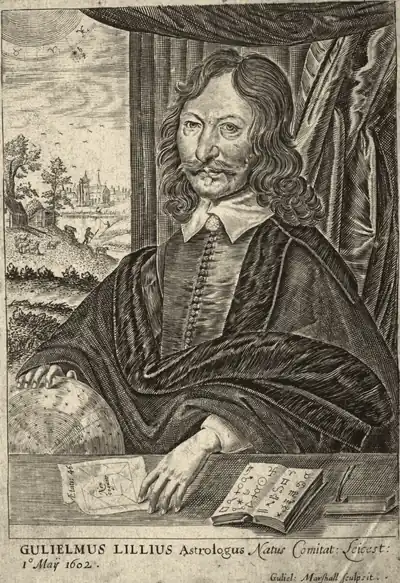
The text is J. M. Ashmand's 1822 translation, checked word by word between two scans of the 1822 printing (Wellcome Library and Harvard). Pages are cited as the 1822 printing numbers them. The portrait is William Marshall’s engraving of Lilly from the front of the 1659 printing (Wellcome Library, public domain).