♄ Free Saturn Sign Calculator
Umbriel's free Saturn sign calculator finds your natal Saturn (its sign, exact degree and house) from your birth date, time and place.
Free, no account, no email. Runs in your browser.
14160+ people cast their chart here in the last 30 days.
No account, no email. Saturn takes about 29.5 years to go round the zodiac, close to two and a half years in each sign, so everyone born within a couple of years of you shares it, and the house is what makes it yours.
- What you'll needBirth date (time and place for the house)
- What you getYour Saturn sign and exact degree, the house it falls in, whether it was retrograde, and every aspect it makes
- CostFree, no account required
What a Saturn sign is
Your Saturn sign is where Saturn stood at your birth. It is traditionally associated with limits, structure and time: what you take seriously, where you feel tested, what you build slowly and keep. Older astrology called Saturn the greater malefic and gave it old age, duty, fear, walls and foundations, which is a grim list on the page and, for most people, the place in the chart where the most lasting work gets done.
Deeper.a cup-of-tea read
Saturn is the slowest of the planets visible to the naked eye. It takes about 29.5 years to circle the Sun, so it spends roughly two and a half years in each sign, and everyone born within a couple of years of you has it in the same sign. The sign is therefore a shared, near-generational placement, read for what a cohort was taught to fear and to respect, while the house it falls in and the aspects it makes are what turn it into something about you. Read the house first.
Every year Saturn turns retrograde for about four and a half months, so it appears to move backwards for more than a third of its life, and more than one person in three is born with it retrograde. The backward loop also means a sign can hold Saturn for close to three years, with a few months of overlap on either side. Its slowness gives it the most famous timing in astrology: at about 29 and a half, and again at about 59, Saturn comes back to the degree it held at your birth, the Saturn return, which traditional astrology reads as the moment the structures of a life are tested and either kept or rebuilt.
How Umbriel computes it
Deeper.a cup-of-tea read
Your Saturn sign is the zodiac sign that Saturn was in, seen from Earth, at your birth moment. Umbriel computes Saturn's position from a planetary theory for the day number of your birth, converts it to a geocentric ecliptic longitude using the Sun's position, and reads the sign as the longitude divided by 30, with the degree as the remainder. Whether Saturn was retrograde is taken from its motion across a half-day step around your birth moment, and its daily speed is kept. Your birth time is turned into UT through the IANA time-zone database, so date, time and place fix the moment. The house is the only part that needs an exact birth time and place: it comes from the cusps of your chosen house system, and without a birth time Umbriel gives no house at all. The sign does not depend on the birthplace, and it depends on the time only if Saturn changed sign on your birthday, which is rare for a planet that moves about a thirtieth of a degree a day. Where that is the case Umbriel says so, and names both signs rather than picking one.
What's in your result
Deeper.a cup-of-tea read
- Sign and exact degreeTo the degree and minute, which is what the Saturn return is timed from, and what matters when Saturn sits near a sign boundary.
- The house it falls inWhere the work and the weight tend to show up. This is the part that needs your birth time, and the part that makes a shared sign personal.
- Retrograde or directWhether Saturn was moving forward at your birth, and how fast, including the near-station slowness either side of a turn.
- Every aspect it makesEach contact with its exact orb, and whether it was applying or separating.
- Its dignityWhether Saturn sits in a sign it rules (Capricorn or Aquarius), is exalted in (Libra), or is in detriment or fall, which traditional astrology reads as how comfortably it works.
- The sign's rulerWhere Saturn's dispositor sits. The placement the whole Saturn story answers to.
Don’t know your birth time?
Deeper.a cup-of-tea read
Know it roughly? Give the time and say where it came from (a certificate, a parent’s memory, or something rough like “early morning”), and your chart tells you what could change within that window.
Don’t know it at all? Umbriel does not fill the gap with a guess. Tick “I don’t know the time at all” and it checks your whole birthday, hour by hour, then tells you two things: which placements are the same whatever time you were born, as exact as they would be if you knew the minute, and which are down to two signs, both named, so you know what a parent’s memory would settle.
The Ascendant, the Midheaven and the houses are left out rather than approximated. A birth time is the one thing they cannot be computed without, and an approximate Rising sign that looks exact is worse than no Rising sign at all.
Common questions
Can I find my Saturn sign without a birth time?
Almost always, yes. Saturn spends about two and a half years in a sign, so the date is nearly always enough. The only exception is a birth within a day or so of Saturn changing sign, where the hour decides it, and Umbriel names both signs when that happens. What you cannot get without a time is the house, and Umbriel leaves that blank rather than guessing.
What does the Saturn sign mean?
It is traditionally read for limits, structure and time: what you take seriously, where you feel tested, what you build slowly. Because everyone born within a couple of years of you shares it, the sign is read for the character of a cohort, and the house is what makes it personal. Best held as a prompt to think with, not a rule about you.
What does it mean if my Saturn is retrograde?
It means Saturn appeared to move backwards at your birth, which it does for about four and a half months every year, so more than one person in three has it. It is traditionally read as a more inward sense of duty, standards set from within rather than taken from outside. It is not a flaw, and it is far too common to be one.
When is my Saturn return?
When Saturn comes back to the exact degree it held at your birth, which happens at about 29 and a half, again at about 59, and for some people a third time near 88. The exact dates depend on your natal degree and on Saturn's retrograde loops, which can make it cross that degree three times over a year. Umbriel's Saturn return calculator works the dates out from your chart.
Is this Saturn sign calculator free?
Yes: sign, degree, house, retrograde status and aspects, with no account and no email, calculated in your own browser.
What if I don’t know my birth time?
Umbriel checks your whole birthday hour by hour and separates what is certain from what is not. Placements that are the same whatever time you were born are shown as exact. Placements that changed sign during the day are shown as two named signs, so you know what a parent's memory would settle. The Ascendant, Midheaven and houses are left out rather than approximated. They cannot be computed without a time, and an approximate Rising sign that looks exact is worse than none.
Do I need an account or an email address?
No. There is no sign-up, no email capture and no free trial. Enter your details and the result is drawn in your own browser.
Go deeper
Every one of these is a page in its own right, written out one at a time.
Related free tools
 Next doorSaturn Return CalculatorUmbriel calculates your actual Saturn return dates free, not the rule-of-thumb age.
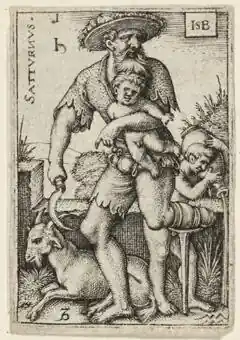
Further down the page: Sebald Beham, Saturn, plate one from The Seven Planets with the Zodiacs, 1539, Art Institute of Chicago. The next-door print comes from that page's own head. The pointing hand: a pointing hand, after a medieval manuscript margin (line art by Jerimee).
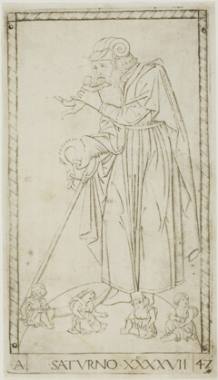
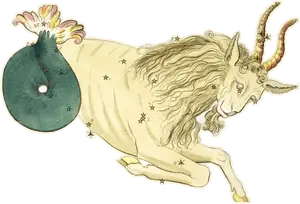
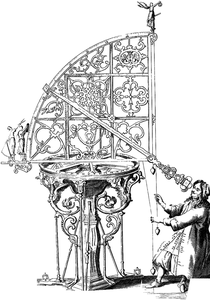
Prints in the head of this page, all public domain except where stated: Saturn, plate 47 from Planets and Spheres, Master of the E-Series Tarocchi, c. 1465, Art Institute of Chicago; Urania's Mirror, Sidney Hall, 1825, Library of Congress via Wikimedia Commons; Johannes Hevelius, Machina coelestis, Danzig, 1673, Houghton Library.
Umbriel offers every system here as a set of prompts to think with, never as a statement of fact about who you are. Take what's useful, leave the rest.