The Rise and Progress of Astronomy
Creech's summary of Book I, then Manilius announces he is the first to put the stars into a poem, and tells how people learned to read the sky.
[p. 1] The Argument
After a short Account of his Design, and a complemental Address to Augustus, he begins, 1. With the Rise and Progress of Astronomy, and other Arts: 2. Discourseth of the several Opinions concerning the Beginning of the World: 3. Describes the Order of it: 4. Proves the Earth to be the Centre of the World: 5. Proves it to be round: 6. Asserts the Soul of the World: 7. Reckons up the Signs of the Zodiack: 8. Describes the Axis: 9. The Northern Constellations: 10. The Constellations between the Tropicks and the South-pole: 11. Explains the Figures of the Constellations: 12. Asserts Providence against Epicurus: 13. Discovers the Bigness of the World: 14. Treats of the movable and immovable Circles: 15. Makes a long description of the Milky-way: 16. Reckons up the Planets: 17. Discourseth of Comets and Meteors, and concludes that they presage.
[p. 2] The Subject of the Poem
Stars conscious of our Fates and Arts ¹Divine,The wondrous work of Heaven's first wise design,In numerous Verse I boldly first incloseToo high a Subject, and too great for Prose.At what the Ancients with a wild amazeAnd ignorant wonder were content to gaze,My Verse brings down from Heav'n, design'd to showCelestial secrets to the World below:What yet the Muses Groves ne'er heard, I sing,And bring unusual offerings to their spring.
The Invocation
Rome's Prince and Father, Thou whose wide commandWith awfull sway is stretcht o'er Sea and Land,Who dost deserve that Heaven thy Love bestow'dOn thy great Father, Thou thy self a God,Now give me Courage, make my Fancy strong,And yield me vigour for so great a Song.
Nor doth the World this curious search refuse,It kindly courts the daring of my Muse,And will be known; whilst You serenely reign,Instruct our Labour, and reward our Pain.Wings raise my Feet, I'm pleas'd to mount on high,Trace all the Mazes of the liquid Sky,Their various turnings, and their whirls declare,And live in the vast regions of the Air:I'll know the Stars, which yet alone to gainIs knowledge mean, unequal to the Pain;For doubts resolv'd it no delight affords,But fills soft empty heads with ratling words:I'll search the Depths, the most remote recess,And flying Nature to Confession press;I'll find what Sign and Constellation rule,And make the difference 'twixt the Wise and Fool;My Verse shall sing what various Aspect reignsWhen Kings are doom'd to Crowns and Slaves to Chains.I'll turn Fate's Books, there reade proud Parthia's doom,And see the sure Eternity of Rome.
[p. 3] The Difficulty
Two Temples rais'd with sacred Incense shine,I bow at Nature's and the Muses shrine;Both aids I need, for double Cares do throng,And fill my Thought; the Subject and the Song:And whilst I'm bound to Verse with Orbs immenseThe World rouls round me, and distracts my sense;Vast is my Theme, yet unconceiv'd, and bringsUntoward words scarce loosned from the Things.
Who first below these wondrous secrets knew?Who stole that knowledge which the World withdrew?Whose soaring mind those Airy mazes trodAnd spight of Heaven desir'd to seem a God!Open the Skies, and teach how Stars obey,And run their race as Nature marks the way,Their Power and Influence, what directs their CourseWhat whirls them round, and what confines their force.
First Mercury disclos'd these mysteries,By Him we view the Inside of the Skies,And know the Stars, and now Mankind admiresThe Power, not onely Lustre of their Fires:By Him all know how great, how just and wise,And good is the Contriver of the Skies;At whose Command the Stars in order met,Who times appointed when to rise and set;That Heaven's great secrets may lie hid no more,And Man instructed gratefully Adore.
[p. 4] Nature disclos'd her self, and from her SpringsPure streams deriv'd o'erflow'd the Minds of Kings,Kings next to Heaven, who o'er the East did sway,Where swift Euphrates cuts his rapid way,Where ²Nile o'erflows, and whence the Whirl restoresThe Day to Us, and passing burns the Moors,And next o'er Priests, whose constant Cares employdIn publick service did obleige the God,His Presence did their holy minds inspireWith sacred flames, and rais'd their fancies higher,Till by degrees to due perfection wroughtHe made himself the Object of their thought:
Such were those wondrous Men who first from farLookt up, and saw Fates hanging at each Star:Their thoughts extended did at once compriseTen thousand revolutions of the Skies,They markt the Influence, and observ'd the PowerOf every Sign, and every fatal Hour;What Tempers they bestow'd, what Fortunes gave,And who was doom'd a King, who born a Slave;How Aspects vary, and their change creates,Though little, great variety in Fates.
Thus when the Stars their mighty Round had run,And all were fixt whence first their Race begun,What Hints Experience did to search impartThey join'd, and Observation grew to Art;Thus Rules were fram'd, for by Example shownThey knew what would be, from what had been done;They saw the Stars their constant Round maintain,Perform their Course, and then return again;They on their Aspects saw the Fates attend,Their change on their Variety depend;And thence they fixt unalterable Laws,Settling the same Effect on the same Cause.
[p. 5] Before that time Life was an artless StateOf Reason void, and thoughtless in debate:Nature lay hid in deepest Night below,None knew her wonders, and none car'd to know:Upward men look, they saw the circling light,Pleas'd with the Fires, and wondred at the sight:The Sun, when Night came on, withdrawn, they griev'd,As dead, and joy'd next Morn when He reviv'd;But why the Nights grow long or short, the DayIs chang'd, and the Shades vary with the Ray,Shorter at his approach, and longer grownAt his remove, the Causes were unknown:For Wit lay unimprov'd, the desart plainsWere unmanur'd, nor fed the idle Swains:Ev'n Gold dwelt safe in Hills, and none resign'dTheir lives to Seas or wishes to the Wind;Confin'd their search, they knew themselves alone;And thought that onely worthy to be known:
But when long time the Wretches thoughts refin'd,When Want had set an edge upon their Mind;When Men encreast, and Want did boldly press,And forc'd them to be witty for redress;Then various Cares their working thoughts employ'd,And that which each invented all enjoy'd.Then Corn first grew, then Fruit enricht the grounds,And barbarous noise was first confin'd to sounds:Through Seas unknown the Sailer then was hurl'd,And gainfull Traffick joyn'd the distant World:Then Arts of War were found, and Arts of Peace,For Use is always fruitfull in encrease.New hints from settled Arts Experience gains,Instructs our Labour, and rewards our Pains:Thus into many Streams one Spring divides,And through the Valleys rouls refreshing Tides.
[p. 6] But these were little things compar'd, they knewThe voice of Birds, in Entrails Fates could view;Burst Snakes with charms, and in a Bullock's bloud,See Rage appeas'd, or fear an angry God.They call'd up Ghosts, mov'd deepest Hell, the SunCould stop, and force a Night upon his Noon;Then make him rise at Night, for all submitTo constant Industry, and piercing Wit.
Nor stopt they here, unwearied IndustryRose boldly up and mounted through the Sky,Saw all that could be seen, view'd Nature's Laws,And young Effects still lying in their Cause.What wings the Lightning, why from watry CloudsThe Thunder breaks, and roars the wrath of Gods.What raiseth Storms, what makes the Winds to blow,Why Summer's Hail's more stiff than Winter's Snow:What fires Earth's Entrails, what doth shake the Ball,Why Tempests rattle, and why Rain doth fall:All this she view'd, and did their modes explain,And taught us to admire no more in vain.Heaven was disarm'd, mad Whirlwinds rul'd above,And Clouds and Vapors thundred instead of Jove.
These things explain'd, their hidden Causes known,The Mind grew strong, and ventur'd boldly on;For rais'd so high, from that convenient riseShe took her flight, and quickly reacht the Skies;To every Constellation Shapes and NamesAssign'd, and markt them out their proper frames;Then view'd their Course, and saw the Orbs were mov'dAs Heaven did guide, and as the World approv'd;That Chance was baffled whilst their Whirls createThe interchang'd Variety of Fate.
[p. 7] This is my Theme, ne'er yet in Numbers wrought,Assist me, Fortune, and improve my thought;Equal my Mind to my vast task; prolongMy life in ease, smooth as my flowing Song;That while my Muse is working o'er the Heap,And forms this Chaos to a pleasing shape,I may with equal care, and equal heat,Declare the Little and disclose the Great.
But now since Fate and Verse do joyntly flowFrom Heaven, and both rule equally below.First let my Muse whole Nature's Face design,Its Figure draw, and finish every Line.
The notes
¹ Whether Divinas is to be rendred Divining or Divine is not yet agreed by the Interpreters of the Poet; by rendring it Divine, Manilius is freed from a redundancy of Words, and the Origine of Astronomy, which he so often inculcates in other places, is hinted at: beside, Divinus seldom signifies Divining, but when a Substantive follows which determines it to that sense, as Divina imbrium, and the like, and in that case I find Milton venturing at it in his Poem:
—Divine of future Woe. (Creech’s note, 1697)
² It seems very plain that this whole description respects onely the Eastern Kings, and therefore Manilius must be reckoned amongst those who believed the head of Nile to be in the East; and lest he might be thought to have forgotten the Egyptians, I am inclin'd to think he includes them under the Priests, to whose care Astronomical Observations were peculiarly committed. (Creech’s note, 1697)
In the app the old words open a note in the margin when you tap them, the old books read the planets of your own chart, and each book opens where you left it. Free, no account, no email.
14160+ people cast their chart here in the last 30 days.
Keep reading
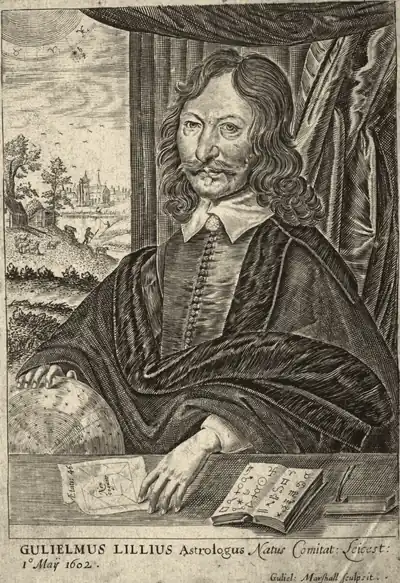
The text is Thomas Creech's 1697 verse translation, checked word by word between three scans of the same type (the 1697 printing, the 1700 printing and a third copy). The long s is printed as s; every other spelling is Creech's. Pages are cited as the 1697 printing numbers them. The portrait is William Marshall’s engraving of Lilly from the front of the 1659 printing (Wellcome Library, public domain).