Different Opinions about the beginning of the World
Where did the world come from? Seeds, fire, water, atoms: the old guesses, lined up and weighed.
[p. 7] Whether from Seed it ne'er ³began to be,Secure from Fate, and from Corruption free;Knew no Beginning, and no Ending fears,But was, and will be, as it now appears.Or huddled ⁴Chaos by a wondrous BirthArcht the vast Sky and fixt the solid Earth;And when this shining World once rais'd its HeadTo Shades Infernal banisht Darkness fled.Or whether unseen ⁵Atoms blindly thrownCompos'd it, and as Years whirle nimbly on,It must dissolve, and as it first was wroughtFrom almost Nothing, fall to almost Nought.Or rose from working ⁶Fire's enlivening Rays,Which form Heaven's Eyes, and live in every Mass,In Thunder roar, and in the Lightning blaze.
[p. 8] Or whether ⁷Water which combines the FrameCompos'd, and keeps it from the loosning Flame.Or whether ⁸Water, Air, and Flame and EarthKnew no beginning, no first seeds of Birth;But first in Being from themselves arose,And as four Members the vast God compose;In which Thin, Thick, Hot, Cold, and Moist and Dry,For mutual Actions mutual parts supply.From whose agreeing disagreement springs,The numerous odd Variety of Things.These Qualities to act provoke the Seed,Make Vital Elements and Bodies breed.
The notes
³ This was the Opinion of Xenophanes, Melissus, Aristotle and others; and Pliny thus concludes in the second Book cap. 1. of his Natural History: 'Tis reasonable to believe that the World is a Deity, eternal and immense, that never had a beginning, and never shall have an end. As absurd an Opinion as ever was propos'd, and repugnant to all the Appearances of Nature; look upon the Rocks on the Sea shore, and having observ'd their continual wearing, consider how few thousands of years they must have stood: direct thy eye to Heaven, and view the several changes in that which was thought impassible; and in short, reflect on the essential vileness of matter, and its impotence to conserve its own being; aud then I believe you will find reason to put this Opinion amongst those absurdities which Tully hath allotted to one or other of the Philosophers to defend. (Creech’s note, 1697)
⁴ This blind fancy we owe to the Phoenicians, who (if Philo Biblius's Sancuniathon may be trusted) taught that the Principles of the Universe were a Spirit of dark Air, and a confus'd Chaos; this Spirit at last began to Love, and joyning with the Chaos, produced Mot or slime, and thence fashioned the World. And hence likely the more sober part of the Greek Philosophers, (for they were but borrowers of Learning) who requir'd two eternal principles, the one active and the other passive, such as Plato, Anaxagoras, &c. took their notions, and having added some few new ornaments, vented them for their own. (Creech’s note, 1697)
⁵ The Philosophy of Epicurus is too well known to need any explication. (Creech’s note, 1697)
⁶ The Opinion of Heraclitus, concerning which see the first Book of Lucretius. (Creech’s note, 1697)
⁷ Thales the Milesian endeavoured to establish this by Arguments drawn from the Origine and Continuation of most things: The seminal Principle of Animals is humid, Plants are nourished by mere Water; Fire it self cannot live without Air, which is onely water rarefied, and the Sun and Stars draw up vapors for their own nourishment and support. These were the considerations upon which he grounded his Opinion; and hence 'tis easie to guess that he kept up the credit of his School rather by those riches which he gain'd by his lucky conjecture at the scarcity of Olives, than by the strength of argument and reason. (Creech’s note, 1697)
⁸ The Assertion of Empedocles, agreeable to which Ovid sings,
Quatuor aeternus genitalia Corpora Mundus
Continet —. (Creech’s note, 1697)
In the app the old words open a note in the margin when you tap them, the old books read the planets of your own chart, and each book opens where you left it. Free, no account, no email.
14160+ people cast their chart here in the last 30 days.
Keep reading
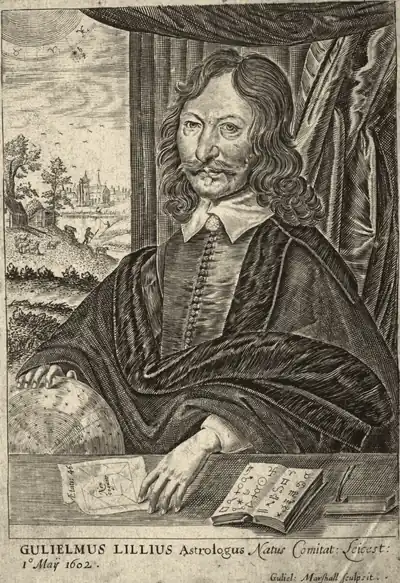
The text is Thomas Creech's 1697 verse translation, checked word by word between three scans of the same type (the 1697 printing, the 1700 printing and a third copy). The long s is printed as s; every other spelling is Creech's. Pages are cited as the 1697 printing numbers them. The portrait is William Marshall’s engraving of Lilly from the front of the 1659 printing (Wellcome Library, public domain).