The Order of the Frame
Nobody knows how it began, but the shape is clear: fire on top, earth at the bottom, everything else in order between.
[p. 8] What 'twas at first, and whence the All beganIs doubted, and the Doubt too deep for Man;And let it be, but whencesoe'er it cameIts Face is certain, 'tis an order'd Frame.
Upward the ⁹Flame on active Pinions fled,To Heaven's high Arch it rais'd its shining Head,There stopt as weary grown, and round the FrameFor Nature's Bullwark roll'd a Wall of Flame.Then liquid Air spread through the empty spaceLess light and active took the second place.But next the Flame the lightest parts aspireTo waste themselves, and feed the greedy Fire.The heavyer Water makes an humbler Claim,And lies the third in order in the Frame;That Vapours rising may, like Seed, repairWhat Fire destroys, and feed decaying Air:
Weight sank round Earth to the remotest place,And floating Sand in clinging Mud's embraceStuck fast, whilst Seas squeez'd out flow'd o'er the Mass:As those grew limpid, and diffus'd the Waves,Through spacious Hollows and descending CavesRocks started forth, their Heads the Mountains rear'd;And Earth surrounded by the Floud appear'd.Lowest of all, and in the midst it liesCompass'd by Seas, and cover'd by the Skies.The Place doth fix it, for still rising higherThe other Elements equally retire,And that by falling stops its farther fall,And hangs the midst and lowest of them all,Its parts to one fixt point press jointly down,And meet, and stop each other from moving on.
The notes
⁹ There is something in this scheme of Manilius so like the ingenious conjecture of the excellent Authour of the Theory of the Earth, that what reflects on the one must have an influence on the other, and when the fiction is confuted the serious discourse will find it self concern'd: The Stoicks held the material part of their Deity to be changeable, and that too as often as the fatal Fire prevail'd, and reduc'd the Elements into one Chaos; in such a confusion the Poet supposeth the first matter of his World, and then makes the different parts separate, and take proper places, according as they were light or heavy: agreeable to this Opinion the Theory of the Earth supposeth a Chaos, which he defines to be a Mass of Matter, fluid, consisting of parts of different sorts and sizes, blended together without any union or connexion. The solid and heavyer parts of this Chaos descend to the Centre, by their own weight, and there fixing and growing hard, compose the inward Body of the Earth; the lighter parts fly upward, and being continually agitated, make that Body which we call Air; the middle sort being somewhat heavyer, and not so much agitated, cover-over the solid interiour Body of the Earth; and its fat and oily parts rising, and swimming on the surface, stop and detain those heavyer particles which upon the first separation were carried up by the Air, and afterward according to their several degrees of Gravity fell back again toward the Centre: These particles sticking in this oily matter, made a soft crust, which in time being hardned by the Sun and those breezes which always attend its motion, became the habitable Earth. This Earth thus form'd was solid, and without Caverns, nor had it any inequalities on its surface; as to its site, its Axis was parallel to the Axis of the Ecliptick, both its Poles being equally inclin'd to the Sun; and as to its figure it was Oval. These are the few easie principal parts of that excellent Hypothesis, settled on the obvious notions of Gravity and Levity, and on the acknowledged Nature, and allow'd Motion of a Fluid. And from these so many curious propositions are naturally deduced, so many difficulties concerning Paradise and the Floud happily explain'd, and all set off with that neatness and aptness of expression, and that variety of curious thought, that I am very much inclin'd to believe that Nature was never so well drest before, nor so artificially recommended. And it is pity that the first acknowledged Principles of Philosophy will not allow it to be true. Inherent Qualities are now generally exploded, as unphilosophical, not to be understood, and unfit to explain the Phaenomena of Nature. The Acceleration of a heavy Body in its descent (beside a thousand other Arguments) quite overthrows Gravity both as an accident of Aristotle, and as essential to Matter, according to the fancy of Epicurus; so that this motion proceeds onely from external impulse, and depends upon the present order of the World. So that Philosophy will not allow the supposition of Gravity or Levity in a confus'd Chaos, since it can sufficiently demonstrate that they are neither inherent qualities, nor essential to matter, and that it is in vain to look after them, before the system of the World was settled in the present order. From this hint it is easie to infer that the supposed Chaos would have still continued such, the solid Parts would have been agitated this or that way indifferently by the restless particles of the Fluid, but there could have been no orderly separation, because no Principle of it.
But suppose such a separation, why must the outward Crust of the Globe be without Caverns in its Body, and Inequalities on its Surface? What Law of Nature doth necessarily prove that in such a confusion the solid parts must be equally dispersed through the Body of the Air? If we trust our Eyes, and look upon a Dust raised by the ruin of a House, or onely consider what Confusion is, it will be very hard to find such a regular and orderly disposition. And since these solid Bodies may be unequally dispers'd, and every one of them tends to the Centre by a direct Line, whenever they settle, the Body which they compose must be unequal in its surface.
Yet to let this Difficulty pass, its Figure according to this Hypothesis will be much more Oval than common observation will allow, for since it is said to be Oval because the Motion of the Aequator is swifter than that of the Polar Circles, the figure must be almost as much Oval, as the Circle of the Aequator is bigger than the Circle of the Pole; there being nothing to hinder the utmost effect of this motion but the weight of the Fluid endeavouring to reduce it self to a Levell, which of what moment it will be in this Case I leave to be considered.
And as for its site, that renders the torrid and the frigid Zones unhabitable; intolerable Heats still burning the former, and the continual gathering and dropping of the vapours making the others too cold and moist to entertain either Man or Beast. And this one concession, I am afraid, spoils most part of the Contrivance; for these portions of the Crust could never grow hard, being continually moistned by the Vapours, and so little expos'd to the Sun, or that breeze which attends its motion: And therefore, whenever Vapours were drawn from the Abyss in the Torrid Zone, these parts of the Arch being not firm enough to sustain themselves, must sink in; and those Vapors that were imprisoned between the surface of the Abyss and the solid part of the Crust of the Earth, might have found an easie passage through this soft portion of the Crust, and therefore could not contribute to the general dissolution of the Frame. Besides, from such a muddy Fountain what could be expected but streams unwholsome and corrupted, and unfit for that end for which they were design'd, and for that use, to which sacred Scripture tells us they were imploy'd?
A great many other inconveniences in Nature may be observ'd to follow this Contrivance; but because this Hypothesis was not set up for its own sake, but to give an intelligible account of Noah's Floud; I shall close these reflexions with a few considerations upon that.
And first the Authour pleads for an universal Floud, it being inconsistent with the demonstrated Nature of a Fluid, that Water should stand up in Heaps fifteen Cubits above the tops of the highest Mountains. This I am willing to admit, though there is no reason why Omnipotence might not be immediately concern'd in this, since he himself confesseth, that the forty days Rain cannot according to his Hypothesis be explain'd by any Natural Cause that he can find out.
Secondly, He compares the height of the Mountains and the Depth of the Sea, and having as to both made allowable suppositions (though the Course of the longest River, even the Nile it self, will not prove its head to be above three foot higher than its mouth) he infers that eight Oceans will be little enough to make an universal Deluge: The Waters above the Firmament are exploded; the Rain would afford but the hundredth part of such a Mass of Water, unless the showers were continual, and over the face of the whole Earth, and the Drops came down ninety times faster than usually they do. (Though here a Man would be apt to think from the expressions in Genesis, The Windows of Heaven were opened, that there was somewhat very extraordinary in this Rain, and that all those requir'd conditions were observ'd.) The Caverns of the Earth, if they threw out all the Water they contain'd, could afford but little in comparison of the great store that was requir'd; And if the whole middle region of the Air had been condens'd, still there had not been enough, because Air being turn'd into Water filleth onely the hundredth part of that space which it formerly possess'd. Though all the other ways by which some have endeavour'd to explain the Floud, were demonstrably insufficient, yet this last which gives an account of it from so natural and easie a Cause as the condensation of the Air deserved to be considered a little more; but it is the Art of a Disputer to touch that least which presseth most on that Opinion which he would advance. For it being allowed that Air by natural Causes may be chang'd into Water, and a Vacuum in this very Chapter being excluded, it necessarily follows, that as much Air as riseth fifteen Cubits higher than the tops of the Mountains is sufficient to make such a Deluge as is describ'd to have been in Noah's time. Because where there is no Vacuum, there can be no contraction into a less space, and every particle of Matter, whatever form or schematism it puts on, must in all conditions be equally extended, and therefore take up the same Room. But suppose a Vacuum, or (as it happens in our imperfect condensations) that a hundred cubical feet of Air would make but one foot of Water, yet sure the Region is large enough to make amends for this disproportion: Now since Nature is sufficient for condensation, and since its powers may be considerably invigorated for the execution of the Almighty's wrath; why must it be thought so difficult to explain a Deluge? and why should an excellent Wit waste it self in fashioning a new World, onely to bring that about which the old one would permit easily to be done? It is above the Province of Philosophy to make a World, let that be suppos'd to have been form'd as it is reveal'd, it is enough for us to search by what Laws it is preserv'd; and a system erected on this foundation will be agreeable both to Reason and to Religion. (Creech’s note, 1697)
In the app the old words open a note in the margin when you tap them, the old books read the planets of your own chart, and each book opens where you left it. Free, no account, no email.
14160+ people cast their chart here in the last 30 days.
Keep reading
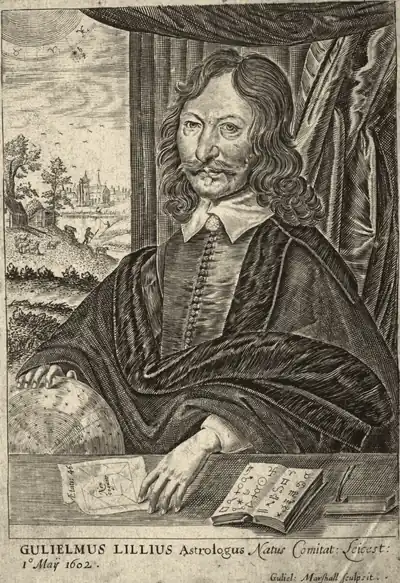
The text is Thomas Creech's 1697 verse translation, checked word by word between three scans of the same type (the 1697 printing, the 1700 printing and a third copy). The long s is printed as s; every other spelling is Creech's. Pages are cited as the 1697 printing numbers them. The portrait is William Marshall’s engraving of Lilly from the front of the 1659 printing (Wellcome Library, public domain).