Providence against the Epicureans
The sky is too orderly to be an accident. Manilius argues with the Epicureans.
[p. 21] A most convincing Reason drawn from Sense,That this vast Frame is mov'd by Providence.Which like the Soul doth every Whirl advance;It must be God, nor was it made by Chance;As Epicurus dreamt, He madly thoughtThis beauteous Frame of heedless Atoms wrought,That Seas and Earth, the Stars and spacious AirWhich forms New Worlds, or doth the Old repair,First rose from these, and still supply'd remain,And All must be, when Chance shall break the Chain,Dissolv'd to these wild Principles again.Absurd and Nonsense! Atheist use thine Eyes,And having view'd the order of the Skies,Think, if Thou canst, that Matter blindly hurld,Without a Guide should frame this wondrous World.
But did Chance make, and Chance still rule the WholeWhy do the Signs in constant order roll?Observe set Times to shut and open Day,Nor meet, and justle, and mistake their Way?Perform their Course as if by Laws confin'd,None hasten on, and leave the rest behind.Why every Day doth the discovering Flame,Show the same World, and leave it still the same?E'en then when ¹⁷Troy was by the Greeks o'erthrown,The Bear oppos'd to bright Orion shone;She near the Pole in narrow Rounds did move,He fac'd her then, and measur'd the vast space above.And e'en at Night when Time in secret flies,And veils himself in Shades from humane Eyes,They by the Signs could know how fast He fled,And in the Skies the hasty Minutes read.
[p. 22] How many Towns have fall'n, what well-built States,Since Troy, have sunk below oppressing Fates?How many Times hath sporting Fortune hurldThe Chance of Rule and Slavery through the World?How hath she now reverst Troy's ancient Doom,And built her Relicks greater up in Rome?Reviv'd old Ilium doth new Spoyls enjoy,And Greece now bends beneath the Fate of Troy.
Why should I count how oft the Earth hath mourn'dThe Sun's retreat, and smil'd when he return'd?How oft he doth his various Course divide'Twixt Winter's Nakedness and Summer's Pride?All Mortal Things must change. The fruitfull Plain,As Seasons turn, scarce knows her self again;Such various forms she bears: large Empires tooPut off their former Face, and take a new.Yet safe the World, and free from Change doth last,No Years encrease it, and no Years can waste;Its Course it urges on, and keeps its Frame,And still will be, because 'twas still the same.It stands secure from Time's devouring Rage,For 'tis a God, nor can it change with Age.
And that the Sun ne'er drives the rising DayFrom North to South, nor leaves the beaten way;That weary grown He still falls down the WestAt Night, nor turns his Horses to the East;That Light by just Degrees the Moon adorns,First shews, then bends, then fills her borrow'd HornsAnd that the Stars in constant order roll,Hang there, nor fall, and leave the liquid Pole;'Tis not from Chance; The Motion speaks aloudThe wise and steddy conduct of the God,These equally dispos'd in Order lye,Make various Shapes, and chequer all the Skie.Above them nought; To the World's Top they rose,Painting the Roof of Natures Common House;Which in a wide Embrace doth all contain,The spatious Air, the Earth, and raging Main;These Set in order, and in order Rise,As West drives down, or East brings up the Skies.
The notes
¹⁷ Alluding to the two Verses in Homer's sixth Iliad,
Ἄρκτον θ', ἣν καὶ ἄμαξαν ἐπίκλησιν καλέουσιν,
Ἥ τ' αὐτοῦ στρέφεται, καί τ' Ὠρίωνα δοκεύει. (Creech’s note, 1697)
In the app the old words open a note in the margin when you tap them, the old books read the planets of your own chart, and each book opens where you left it. Free, no account, no email.
14160+ people cast their chart here in the last 30 days.
Keep reading
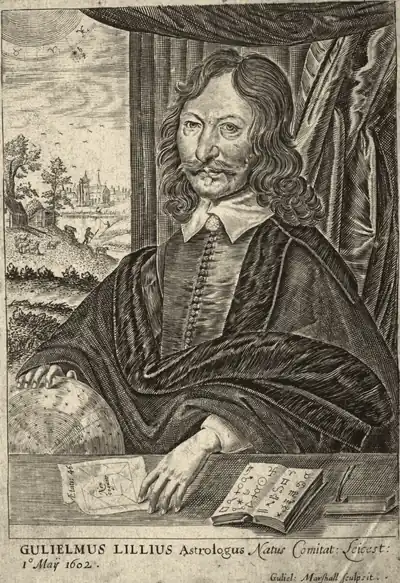
The text is Thomas Creech's 1697 verse translation, checked word by word between three scans of the same type (the 1697 printing, the 1700 printing and a third copy). The long s is printed as s; every other spelling is Creech's. Pages are cited as the 1697 printing numbers them. The portrait is William Marshall’s engraving of Lilly from the front of the 1659 printing (Wellcome Library, public domain).