The bigness of the World
How big is the universe? Too big to see, so reason has to go and look.
[p. 23] But now how vast the Arch, how next immenseThe Zodiack's Round, though far remov'd from Sense,Plain Reason shews; whose Active Force can pierce,The deep Recesses of the Universe.No Bars can stop it, through the World it flies,And Heaven it self lies open to its Eyes.As great a space as Earth, and humble SeasFrom Heaven divide, so great two Signs possess.The World's ¹⁸Diameter by Art is found,Almost the third Division of the Round.Therefore as far as four bright Signs comprize,The distant Zenith from the Nadir lies.And two thirds more almost surround the Pole,The Twelve Signs measure, and complete the Whole.
But since the Earth hangs midst the spacious All,The Solid Centre of the Liquid Ball,Therefore as far as e'er our Eyes can passUpward, or downward, could they pierce the Mass,Till bounding Sky the wearied Sight confines,Is equal to the distance of two Signs.And six such spaces the vast Round completeWhere All the Signs their constant Whirls repeat,And each lies distant in an equal Seat.Nor must you wonder such VarietiesOf different Fates from the same Stars should rise.Since great their Empire, and unlike their force,Their Seats so large, and so immense their Course.
The notes
¹⁸ Demonstrated by Archimedes in his Κύκλου μέτρησις, Prop. 3. That the Circumference of every Circle exceeds three times the Diameter thereof by a part that is less than 1/7th, and greater than 10/71. (Creech’s note, 1697)
In the app the old words open a note in the margin when you tap them, the old books read the planets of your own chart, and each book opens where you left it. Free, no account, no email.
14160+ people cast their chart here in the last 30 days.
Keep reading
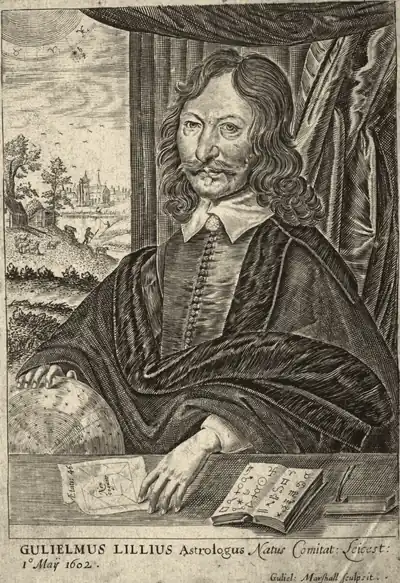
The text is Thomas Creech's 1697 verse translation, checked word by word between three scans of the same type (the 1697 printing, the 1700 printing and a third copy). The long s is printed as s; every other spelling is Creech's. Pages are cited as the 1697 printing numbers them. The portrait is William Marshall’s engraving of Lilly from the front of the 1659 printing (Wellcome Library, public domain).