The movable and immovable Circles
The great circles of the sky: the ones that move with you and the ones that don't.
[p. 24] Thus far advanc't my towring Muse must rise,And sing the Circles that confine the Skies,Describe the track, and mark the shining Way,Where Planets Err, and Phoebus bears the Day.
The Northern Polar Circle
One towards the North sustains the Shining BearAnd lies divided from the Polar Star;Exactly ¹⁹six divisions of the Sphere.
The Tropical Circle of Cancer, or Summer Solstice
Another drawn through Cancer's Claws confines,The utmost Limits of the Fatal Signs;There when the Sun ascends his greatest heightIn largest Rounds He whirls the lazy Night.Pleas'd with his Station there He seems to stay,And neither lengthens nor contracts the Day.The Summer's Tropick call'd. ——It lies the fiery Sun's remotest Bound,Just five Divisions from the other Round.
The Equinoctial
A third twines round, and in the midst dividesThe Sphere, and see the Pole on both its sides.And there when Phoebus drives, He spreads his Light,On All alike, and equals Day and Night.For in the midst, He doth the Skies divide,And chears the Spring, and warms the Autumn's Pride.And this large Circle drawn from Cancer's Flame,Just four Divisions parts the Starry Frame.
The Tropick of Capricorn
Another Southward drawn exactly setsThe Utmost Limits to the Sun's retreats;When hoary Winter calls his Beams away,Obliquely warms us with a feeble Ray,And whirls in narrow Rounds the freezing Day.To Us his Journey's short, but where He standsWith Rays direct, He burns the barren Sands.To wisht-for Night he scarce resigns the Day,But in vast Heats extends his hated Sway.
[p. 25] The Southern Polar Circle
The last drawn round the Southern point confinesThose Bears, and lies the Utmost of the Lines.Wise Nature constant in her Work is found:As five Divisions part the Northern RoundFrom the North point, This Southern Round appearsJust five Divisions distant from its Bears.Thus Heaven's divided, and from Pole to PoleFour Quadrants are the Measure of the Whole.The Circles five, by these are justly shown,The Frigid, Temperate and the Torrid Zone.All these move Parallel, they set, they rise,At equal Distance moving with the Skies;Turn'd with the Orbs the common Whirl repeat,Are fixt, nor vary their allotted Seat.
The Colure
From Pole all round to Pole two Lines exprest,Adversely drawn, which intersect the restAnd one another; They surround the Whole,And crossing make right Angles at each Pole:These into four just parts, by Signs, the SphereDivide, and mark the Seasons of the Year.
The Equinoctial Colure
One drawn from Heaven's high top descends from far,And cuts the Serpent's Tail, and the dry Bear:The Equinoctial Scales, the Snake's Extremes,And next the Southern Centaur's middle Beams;Then thwarts the Adverse Pole, and next dividesThe mighty Whale, and parts its scaly sides;Bright Aries point, and splendid Trigon past,The fair Andromeda below the Waste,And next her Mother's Head it cuts, and thenThe Pole, and closeth in it self agen.
[p. 26] The Solstical Colure
Cross this, and from the Pole doth first appearThe Other, through the forefeet of the Bear,And through its Neck; (which when the Sun retiresFirst shines, and spreads black Night with feeble Fires)Then parts the Twins and Crab, the Dog divides,And Argo's keel that broke the frothy tides.And then the Pole and other Circle crostTo Caper turns contracted in his Frost:The Eagle cuts, and the inverted Lyre,Black Draco's folds ——The hinder Paws o'th' Bear, and near the PoleIt's Tail, and closing there compleats the Whole.These Rounds immovable, their site the same,Here Seasons fix, nor vary in the frame.
The Meridian
Two more are movable: one from the BearDescrib'd surrounds the middle of the Sphere,Divides the Day, and marks exactly NoonBetwixt the rising and the setting Sun:The Signs it changes as we move below,Run East or West, it varies as You go;For 'tis that Line, which way soe'er we tread,That cuts the Heaven exactly o'er our head,And marks the Vertex; which doth plainly proveThat it must change as often as we move.Not one Meridian can the World suffice,It passes through each portion of the Skies;Thus when the Sun is dawning o'er the East'Tis their sixth hour, and sets their sixth at West:Though those two hours we count our days extremes,Which feebly warm us with their distant Beams.
The Horizon
To find the other Line cast round thine Eyes,And where the Earth's high surface joyns the Skies,Where Stars first set, and first begin to shine,There draw the fancy'd Image of this Line:Which way soe'er you move 'twill still be new,Another Circle opening to the view;For now this half, and now that half of SkyIt shews, its Bounds still varying with the Eye.This Round's Terrestrial, for its bounds containThat Globe, and cut the middle with a Plain;'Tis call'd the Horizon, the Round's design,(For 'tis to bound) gives title to the Line.
[p. 27] The Zodiack
Two more Oblique, and which in adverse LinesSurround the Globe, Observe: One bears the SignsWhere Phoebus drives and guides his fiery HorseAnd varying Luna follows in her Course.Where Planets err as Nature leads the Dance,Keep various measures undisturb'd by Chance;Its highest Arch with Cancer's beams do glow,Whilst Caper lies, and freezes in the low:Twice it divides the Equinoctial line,Where fleecy Aries, and where Libra shine.Three Lines compose it, and th' Eclyptick's foundIth' midst; and all decline into a Round.
Nor is it hid, nor is it hard to find,Like others open onely to the Mind;For like a Belt with studs of Stars the SkiesIt girds and graces; and invites the Eyes:To twelve Degrees its Breadth, to thrice sixscoreIts Length extends, and comprehends no more:Within these bounds the wandring Planets rove,Make Seasons here, and settle Fate above.
The notes
¹⁹ Eudoxus divided the Sphere into sixty parts, and this division Manilius follows, and according to that describes the Position of the Celestial Circles. (Creech’s note, 1697)
In the app the old words open a note in the margin when you tap them, the old books read the planets of your own chart, and each book opens where you left it. Free, no account, no email.
14160+ people cast their chart here in the last 30 days.
Keep reading
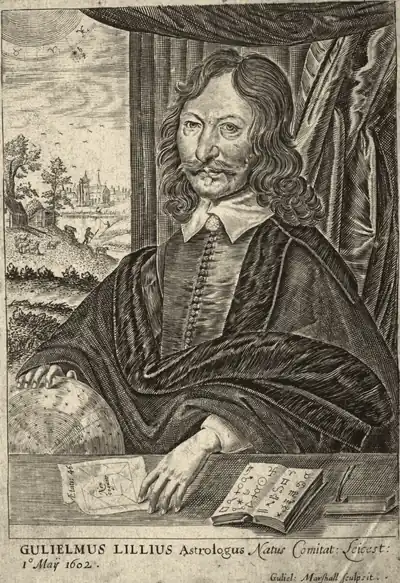
The text is Thomas Creech's 1697 verse translation, checked word by word between three scans of the same type (the 1697 printing, the 1700 printing and a third copy). The long s is printed as s; every other spelling is Creech's. Pages are cited as the 1697 printing numbers them. The portrait is William Marshall’s engraving of Lilly from the front of the 1659 printing (Wellcome Library, public domain).