The Milky way
The Milky Way, the bright road across the night, and the old guesses at what it is.
[p. 27] The other Round from Bears oppos'd begunRuns adverse to the Chariot of the Sun,It leaves the Pole, and from its Round retires,And cuts inverted Casiopeia's Fires:Thence still descending and obliquely drawnIt passes through the Body of the Swan,Then Cancer's fires, the headlong Bird of Jove,The Line and Zodiack, where the Planets rove:And thence in various windings turns to meetThe other Centaur, and entwines his feet:And thence to mount through Argo's Sails begins,The Line, and lowest portion of the Twins;Then joyns the Driver, and from thence ascendsO'er Perseus, and to Cassiopeia tends,There 'tis receiv'd in her inverted Chair,In her the Round begins, and ends in Her.Twice cuts the Tropicks, Zodiack, and the Line,And is as often cut by those agen.
[p. 28] Nor need we with a prying Eye surveyThe distant Skies to find the Milky way,It must be seen by All, for every nightIt forcibly intrudes upon our sight,And will be mark'd for shining streaks adornThe Skies as opening to let forth the Morn.And as a beaten Path that spreads betweenA troden Meadow, and divides the Green.Or as when Seas are plow'd behind the Ship,Foam curls on the green surface of the Deep.In Heaven's dark surface such this Circle lies,And parts with various Light the Azure Skies.Or as when Iris draws her radiant BowSuch seems this Circle to the World below.It all surpriseth, our inquiring sightIt upward draws, when through the Shades of NightIt spreads its Rays, and darts amazing Light.
Fond Men the sacred Causes strive to find,And vainly measure with a feeble Mind:And yet they strive, they madly whirl aboutThrough various Causes, still condemn'd to Doubt.
[p. 29] Various Opinions about the Milky way
Whether the Skies ²⁰grown old, here shrink their Frame,And through the Chinks admit an upper Flame,Or whether here the Heavens two Halves are joyn'dBut odly clos'd, still leave a Seam behind:Or here the parts in ²¹Wedges closely prest,To fix the Frame, are thicker than the Rest,Like Clouds condens'd appear, and bound the Sight,The Azure being thickned into White.
Or whether that old ²²Tale deserves our Faith,Which boldly says, that this was once the PathWhere Phoebus drove; and that in length of YearsThe heated track took Fire and burnt the Stars.The Colour chang'd, the Ashes strew'd the Way,And still preserve the marks of the Decay:
Besides, Fame tells, by Age Fame reverend grown,That Phoebus gave his Chariot to his Son,And whilst the Youngster from the Path declinesAdmiring the strange Beauty of the Signs;Proud of his Charge, He drove the fiery Horse,And would outdoe his Father in his Course.The North grew warm, and the unusual FireDissolv'd its Snow, and made the Bears retire;Nor was the Earth secure, each Countrey mourn'dThe Common Fate, and in its City's burn'd.Then from the scatter'd Chariot Lightning came,And the whole Skies were one continued Flame.The World took Fire, and in new kindled StarsThe bright remembrance of its Fate it bears.
Thus Fame, nor must the softer Fable dieThat Juno's Breast o'erflowing stain'd the Skie,And made that Milky way, which justly drawsIts Name, the Milky Circle from its Cause.Or is the spatious Bend serenely brightFrom little Stars, which there their Beams unite,And make one solid and continued Light?
[p. 30] Or Souls which loos'd from the ignoble ChainOf Clay, and sent to their own Heaven again,Purg'd from all dross by Vertue, nobly riseIn Aether wanton, and enjoy the Skies.Great Atreus Sons, Tydides fixt above,And stout Achilles equal to our Jove;With three-ag'd Nestor: He that bravely stoodThe Dangers of the Land and of the Floud.Ulysses, Nature's Conquerour, enjoyThe Skies deserv'd; with all the Chiefs at Troy.Jove's Son Sarpedon, He that Lycia sway'd:The black Merione, the Martial Maid,Had Fate stood Neuter, Troy's securest Aid.With all those Kings that Greece or Asia bore,Or Pella ²³greatest in her Conquerour.
Next these the grave and prudent Heroes rise,Whose solid Riches lay in being Wise;There good Zeleucus, stout Lycurgus shine,Solon the just, and Plato the Divine.His Master next, whose Bloud unjustly spiltOn Athens still reflects a real Guilt.Next Persia's Scourge who strew'd the joyfull FloudWith Xerxes fleet, and check'd the growing God:Who broke his Force, when Neptune bore the chain,And prov'd his juster Title o'er the Main.
Here Romans joyn'd, the greatest Croud, reside,The Kings, e'er Tarquin stain'd the Throne with Pride,The Horaces our Army in our Wars,The Town which he defended, Cocles bears;Next Clelia rides, the brightest Maid in Fame,And Scevola more glorious by his Maim.Then He on whom the Helping Crow bestow'dA Name, and in the Figure brought a God.Camillus who the Stars deserv'd to gainFor saving Jove, when Thunder roar'd in vain;Patient of wrongs, and whilst alive ador'd,The Founder of that Rome that He restor'd.
[p. 31] Next Brutus sits, and next, unlearn'd in Fear,The fierce Revenger of the Pyrrick War,Papyrius shines; The Decii o'er their FoesIn Triumphs Equal, Rivals in their Vows.Fabritius, Curius, for their Country bold,Alike in Courage, and too great for Gold.Marcellus, Sword of Rome, the third that boreA Royal spoyl, and Cossus grac'd before:Next Fabius sits, who left the Common wayTo Victory, and Conquer'd by Delay.Livy and Nero glorious for the fallOf haughty Carthage in her Asdrubal.The Scipio's Africks Fate both joyn'd in One,The latter ending what the first begun.
Pompey by Thrice the Conquer'd World ador'd,Before God Caesar stoopt to be our Lord:The fam'd Metelli; Tully, Rome's defence,Deserving Heaven for pretious Eloquence.The Claudian Race, and the Emilian LineWith Fortune's Conquerour great Cato shine.But Venus Julian race, who drew their riseFrom Heaven, return again and fill the Skies;Where great Augustus, with his partner JovePresides, and views his Father fixt above.Quirinus joyns him, and is pleas'd to seeThe Caesars grow Rome's Founders more than He.
[p. 32] The highest Arch contains the greater Gods,The Godlike Heroes fill these next Abodes;Those generous Souls, that ran an equal raceIn Vertues Paths, and claim a second place.
Thus far my Muse hath with success been crown'd,Or found no stops, or vanquisht those she found.And thus incourag'd now she boldly daresTo sing the Fatal compacts of the Stars.But stop thy flight, sing all the Fires that shineAnd influence too, and finish thy design.
The notes
²⁰ The Opinion of Diodorus. (Creech’s note, 1697)
²¹ Macrobius reports Theophrastus to be the Authour of this Fancy. (Creech’s note, 1697)
²² From Plutarch we learn that Metrodorus and others asserted this, and Achilles Tatius fixes this foolish Opinion on Oenopides Chius. (Creech’s note, 1697)
²³ The learned Mr. Hayns dislikes Scaliger's reading, which I have followed, and thinks that he meant that Pella was a Woman; a more solemn foppery was never met with, and this Note, beside a great many others, may serve to credit the Dauphin Editions of the Classick Authours. (Creech’s note, 1697)
In the app the old words open a note in the margin when you tap them, the old books read the planets of your own chart, and each book opens where you left it. Free, no account, no email.
14160+ people cast their chart here in the last 30 days.
Keep reading
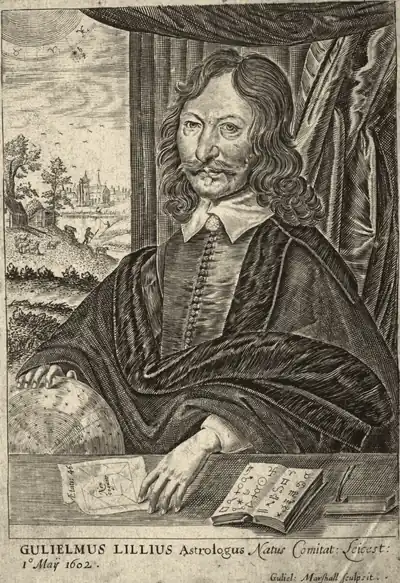
The text is Thomas Creech's 1697 verse translation, checked word by word between three scans of the same type (the 1697 printing, the 1700 printing and a third copy). The long s is printed as s; every other spelling is Creech's. Pages are cited as the 1697 printing numbers them. The portrait is William Marshall’s engraving of Lilly from the front of the 1659 printing (Wellcome Library, public domain).