The whole World Animate, and God the Soul of it
Creech's summary of Book II, a long dig at other poets, then the world as one living creature with God as its soul.
[p. 47] The Argument
Manilius takes care frequently to tell his Reader, that He is the first who ventur'd on an Astrological Poem: He seems mightily pleas'd with his Undertaking, hugs it as his First-born, and the Son of his Strength: He at large acquaints us with the Pains which He suffer'd in bringing it to Perfection, and then reckons up the Beauty of the Child, and what great Hopes He conceives of it: If ever he deserves Scaliger's Character, That he knew not when to leave off, it must be principally then when He speaks of himself and his own Performance. We need look no further than the Beginning of this Book to be satisfied in this matter: He spends about Sixty Verses in reckoning up the chief Subjects of Homer, Hesiod, Theocritus, and other Poets, all which being laid aside, He declares his Design to be wholly new, and then begins, 1. To assert, that the whole World is Animate, and God the Soul of it. 2. The Influence of the Heavens. 3. He reckons up the several kinds or sorts of Signs, as, 4. Male and Female Signs: 5. Human and Brute Signs. 6. Single and Double Signs. 7. Pairs. 8. Double Signs made up of different Species. 9. Signs Double by Place, viz. Those that immediately precede the Four Tropick Signs. 10. Signs of Natural or Unnatural Postures. 11. Day and Night Signs. 12. Earth and Water Signs. 13. Fruitful and Barren Signs. 14. Signs of different Postures. 15. Maim'd and intire Signs. 16. Season Signs. 17. He sings the various Configurations or Aspects of the Signs: As, 18. Trines. 19. Quadrates or Squares; shews what are to be accounted Right and what Left in these Figures: And, 20. Adds several Cautions concerning Squares and Trines. 21. He describes the Intercourse or Agreement of Trines and Quadrates. 22. Of Hexagons or Sextiles, of which he gives a particular Account. 23. Of Contiguous Signs. 24. Of Unequal Signs, 25. Of Opposites. 26. He shews what Gods are the Guardians of each Sign. 27. The Signs for the several parts of the Body, 28. What Signs See, Hear, Love, or Hate each other. 29. He makes a short Digression about Friendship. 30. He treats of the Friendly and Unfriendly Aspects. 31. Of the Dodecatemoria, or Twelfths. 32. Of the Dodecatemoria of the Planets, and proposes two ways to find them. 33. He describes the Celestial Houses, assigning them their Proper Charges and their Titles, together with the Planets which presided in them; and then concludes this Second Book.
[p. 49] Homer
THE mighty Bard in lasting Numbers singsIlium's long Wars, the King of fifty Kings;Brave Hector's Brand, the bloody dreadful Field,And Troy secure behind the Hero's Shield.He sings Ulysses, and his wandring YearsIn Time and Glory equal to his Wars:He sings how twice He conquering plough'd the Main,Whilst Scylla roar'd, and Neptune rag'd in vain,And how at Home He fixt his tottering Throne,Redeem'd his Honour, and secur'd his Son:Usurping Woers felt his thundering Sword,And willing Nations knew their Native Lord.His Subjects these, from whose ¹abundant SpringSucceeding Poets draw the Songs they sing;From Him they take, from Him adorn their Themes,And into little Channels cut his Streams,Rich in his store——
Hesiod
Next Hesiod sings the Gods Immortal Race,He sings how Chaos bore the Earthy Mass;How Light from Darkness struck did Beams display,And Infant-Stars first stagger'd in their way:How Name ²of Brother vail'd an Husband's Love,And Juno bore unaided by her Jove;How twice-born Bacchus burst the Thunderer's Thigh,And all the Gods that wander through the Sky.
[p. 50] Hence He to Fields descends, manures the Soil,Instructs the Plowman, and rewards his Toil;He sings how Corn in Plains, how Vines in HillsDelight, how Both with vast Encrease the Olive fills:How Foreign Graffs th' Adulterous Stock receives,Bears stranger Fruit, and wonders at her Leaves:An useful Work, when Peace and Plenty reign,And Art joyns Nature to improve the Plain.
Eratosthenes
The Constellation's Shapes ³some make their Themes,Sing whence they came, and how adorn'd with Beams,Andromeda enjoys kind Perseu's Aid,The Sire unbinds, the Mother mourns the Maid:Callisto ravisht now the Pole surveys,Nor grieves to change her Honor for her Rays:The Little Bear that rock'd the mighty Jove,The Swan whose borrow'd Shape conceal'd his LoveAre grac'd with Light, the Nursing Goat's repaidWith Heaven, and Duty rais'd the Pious Maid;The Lion for the Honors of his Skin,The squeezing Crab, and stinging Scorpion shineFor aiding Heaven, when Giants dar'd to brave,The threatned Stars; and Thunder fail'd to save:And now the Fish ignoble Fates escapeSince Venus ow'd her Safety to their Shape:The Ram having pass'd the Sea, serenely shines,And leads the Year, the Prince of all the Signs.
Thus whilst by Fables They the Stars advance,They vainly make the Heaven one large Romance;Earth fills the Sky, the Mass ignobly reigns,And Heaven's upheld by that which it sustains:Fables absurd, which Nature's Laws reject,To make the Cause depend on the Effect.
[p. 51] Theocritus
The sweet Theocritus with softest StrainsMakes piping Pan delight Sicilian Swains;Thro' his smooth Reed no Rustick Numbers move,But all is Tenderness, and all is Love;As if the Muses sate in every Vale,Inspir'd the Song, and told the melting Tale.
Macer
Some Birds, some Wars of Beasts, or Serpents write,Snakes in their Poems hiss, and Lions fight:
Nicander
Some Fate in Herbs describe, some Sovereign Roots,Or see gay Health spring up in saving Fruits:
Some old Poet who describ'd Hell
One breaks thro' Nature's stubborn Bars, invadesThe rest, and sacred Silence of the Shades,Turns up the inside of the World, and Night,And brings Eternal Darkness into Light.
Of every Subject now the Muses sing,And Floods confus'd come tumbling from their Spring,Yet dry as fast, nor can Parnassian StreamsSuffice the Throngs that crowd to common Themes.I seek new Springs which roul refreshing WavesThro' Plains untrod, and Purls in hidden Caves,Kept pure for Me, which Birds did ne'er profane,And thirsty Phoebus oft hath sought in vain:My Verse shall be my Own, not stoln, but wrought;Mine, not the Labor of Another's Thought.My Vessel's trimm'd, tho' never launch'd before,I spread my Sails, and boldly leave the Shore:
I'll sing how God the World's Almighty MindThro' All infus'd, and to that All confin'd,Directs the Parts, and with an equal HandSupports the whole, enjoying his Command:How All agree, and how the Parts have madeStrict Leagues, subsisting by each others Aid;How All by Reason move, because one SoulLives in the Parts, diffusing thro' the whole.
[p. 52] For did not all the Friendly Parts conspireTo make one Whole, and keep the Frame intire;And did not Reason guide, and Sense controulThe vast stupendous Machine of the whole,Earth would not keep its place, the Skies would fall,And universal Stiffness deaden All;Stars would not wheel their Round, nor Day, nor Night,Their Course perform, be put, and put to flight:Rains would not feed the Fields, and Earth denyMists to the Clouds, and Vapors to the Sky;Seas would not fill the Springs, nor Springs returnTheir grateful Tribute from their flowing Urn:Nor would the All, unless contriv'd by Art,So justly be proportion'd in each part,That neither Seas, nor Skies, nor Stars exceedOur Wants, nor are too scanty for our Need:Thus stands the Frame, and the Almighty SoulThro' all diffus'd so turns, and guides the whole,That nothing from its setled Station swerves,And Motion alters not the Frame, but still preserves,
The notes
¹ Manilius having mention'd the chief Arguments of Homer's Poems, concludes with a high Character, stiling him the Fountain of all Poetry, Ovid. Amor. lib. 3. El. 8. to the same purpose,
A quo, ceu Fonte perenni,
Vatum Pieriis ora rigantur Aquis.
And Longinus (de sublim. Sect. 13) says not only Stesichorus and Archilocus, but Herodotus the Historian, and Plato the Philosopher, owe their chiefest Beauties to that Poet. (Creech’s note, 1697)
² Several Poems of Hesiod are lost, and Scaliger with other Criticks conjecture, That Manilius refers us to those lost Poems: But I think this and the preceding Verse ought to be Corrected, (of this Correction perhaps I may give an account in a Latin Edition of this Author) and then they will be found in those pieces of Hesiod that are now extant. (Creech’s note, 1697)
³ Eratosthenes a Greek Poet, flourished in the time of Ptolemy Euergetes, about the 138 Olymp. He wrote of the Stars and Constellations, and gave an account of all the Fables relating to them: I have not time to explain all these Fables and therefore shall only direct where they may be found. Concerning Perseus, Andromeda, her Father Cepheus, and her Mother Cassiopeia, vid. Ovid. Metam. lib. 4. ver. 665. Concerning Callisto, or the great Bear, Ovid. lib. 2. ver. 405. The Fable of the Little Bear may be found in Diodorus Siculus, lib. 4. Of the Swan in the First Book of Manilius. Of the Goat in the First Book of Manilius, and in Casaubon's Animadversions on Athenaeus: The Maid or Erigone, is said to be the Daughter of Icarus, who upon the Death of her Father, hang'd her self. The Nemean Lion being slain by Hercules, was placed amongst the Stars for his shining Skin. The Crab for pinching Hercules when he fought the Hydra: The Scorpion for Killing Orion, or rather, for assisting the Gods against the Giants. The Stories of Venus taking the shape of a Fish when she fled from the Giant Typho, and of the Ram who swam over the Hellespont with Phryxus and Helle on his Back, are well known, and may be found in Manilius, and Selden de Diis Syris. (Creech’s note, 1697)
Old words on this page
- viz
- short for videlicet, Latin for "namely".
- native
- the person whose birth chart it is.
In the app the old words open a note in the margin when you tap them, the old books read the planets of your own chart, and each book opens where you left it. Free, no account, no email.
14160+ people cast their chart here in the last 30 days.
Keep reading
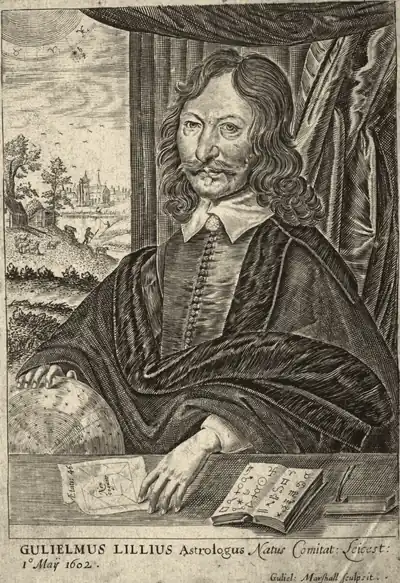
The text is Thomas Creech's 1697 verse translation, checked word by word between three scans of the same type (the 1697 printing, the 1700 printing and a third copy). The long s is printed as s; every other spelling is Creech's. Pages are cited as the 1697 printing numbers them. The portrait is William Marshall’s engraving of Lilly from the front of the 1659 printing (Wellcome Library, public domain).