The Influence of the Heavens
How what happens up there reaches us down here.
[p. 52] This God or Reason, which the Orbs doth move,Makes Things below depend on Signs above;Tho' far remov'd, tho' hid in Shades of Night,And scarce to be descry'd by their own Light;Yet Nations own, and Men their Influence feel;They rule the Publick, and the Private Will:The Proofs are plain. Thus from a different StarWe find a fruitful, or a barren Year;Now Grains encrease, and now refuse to grow;Now quickly ripen, now their growth is slow;
[p. 53] The Moon commands the Seas, she drives the MainTo pass the Shores, then drives it back again:And this Sedition chiefly swells the Streams,When opposite she views her Brother's Beams;Or when she neer in close Conjunction ridesShe rears the Flood, and swells the flowing Tides;Or when attending on his yearly RaceThe Equinoctial sees her borrow'd Face.Her Power sinks deep, it searches all the Main,Testaceous ⁴Fish, as she her Light regains,Increase, and still diminish in her Wain:For as the Moon in deepest Darkness mourns,Then Rays receives, and points her borrow'd Horns,Then turns her Face, and with a Smile invitesThe full Effusions of her Brother's Lights;They to her Changes due proportion keep,And shew her various Phases in the Deep.
So Brutes, whom Nature did in sport create,Ignorant both of themselves, and of their Fate,A secret Instinct still erects their EyesTo Parent Heaven, and seems to make them wise:One at the New Moons ⁵rise to distant ShoresRetires, his Body sprinkles, and adores:Some see Storms gathering, or Serenes foretel,And scarce our Reason guides us half so well.
Then who can doubt that Man, the glorious PrideOf All, is nearer to the Skies ally'd?Nature in Man capacious Souls hath wrought,And given them Voice expressive of their Thought;In Man the God descends, and joys to findThe narrow Image of his greater Mind.But why should all the other Arts be shown,Too various for Productions of our own?
[p. 54] Why should I sing how different Tempers fall,And Inequality is seen in All?How many strive with equal Care to gainThe highest Prize, and yet how few obtain?Which proves not Matter sways, but Wisdom rules,And measures out the Bigness of our Souls:Sure Fate stands fixt, nor can its Laws decay,'Tis Heaven's to rule, and Matter's Essence to obey.
Who could know Heaven, unless that Heaven bestow'dThe Knowledge? or find God, but part of God?How could the Space immense be e're confin'dWithin the compass of a narrow Mind?How could the Skies, the Dances of the Stars,Their Motions adverse, and eternal Wars,Unless kind Nature in our Breasts had wroughtProportion'd Souls, be subject to our Thought?Were Heaven not interessed to advance our Mind,To know Fate's Laws, and teach the way to find,Did not the Skies their kindred Souls improve,Direct, and lead them thro' the Maze above;Discover Nature, shew its secret Springs,And tell the Sacred Intercourse of things,How impious were our Search, how bold our Course,Thus to assault, and take the Skies by force?
But to insist on tedious Proofs is vain,The Art defends it self, the Art is plain;For Art well grounded forces to believe,It cannot be deceived, nor can deceive;Events foretold fulfil the Prophesie,What Fortune seconds, how can Man deny?The Proofs are Sacred, and to doubt would beNot Reason's Action, but Impiety.
[p. 55] Whilst on these Themes my Songs sublimely soar,And take their Flight, where Wing ne're beat before;Where none will meet, none guide my first Essay,Partake my Labors, or direct my way,I rise above the Crowd, I leave the Rude,Nor are my Poems for the Multitude,Heaven shall rejoyce, nor shall my Praise refuse,But see the Subject equall'd by the Muse;At least those favour'd few, whose Minds it shows,The Sacred Maze, but ah! how few are Those!Gold, Power, soft Luxury, vain Sports, and EasePossess the World, and have the luck to please:Few study Heaven, unmindful of their state,Vain stupid Man! but this it self is Fate.My Subject this, and I must this pursue,This wondrous Theme, tho read, and prais'd by few;
The notes
⁴ This was a Fancy of the Antients, which some are not asham'd, after Experience hath so often Confuted it, to maintain still. (Creech’s note, 1697)
⁵ The Elephants do so, if we believe Pliny: Nat. Hist. lib. 8. cap. 1. (Creech’s note, 1697)
In the app the old words open a note in the margin when you tap them, the old books read the planets of your own chart, and each book opens where you left it. Free, no account, no email.
14160+ people cast their chart here in the last 30 days.
Keep reading
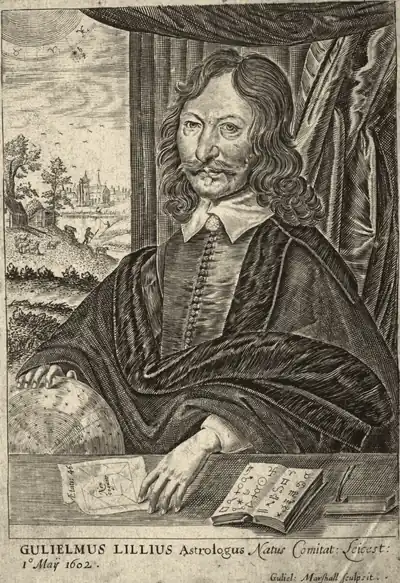
The text is Thomas Creech's 1697 verse translation, checked word by word between three scans of the same type (the 1697 printing, the 1700 printing and a third copy). The long s is printed as s; every other spelling is Creech's. Pages are cited as the 1697 printing numbers them. The portrait is William Marshall’s engraving of Lilly from the front of the 1659 printing (Wellcome Library, public domain).