The Celestial Houses
The four hinges of the sky and the houses between them.
[p. 80] Be careful then, and with a curious Eye,Observe the ³¹four fixt Hinges of the Sky;One constant point their settled place defines,Altho' they vary in their moving Signs:
The Hinges
One fixt i'th' East, where with a gentle RayThe Sun views half the Earth on either way,And here brings on, and there bears off the Day.One in the West, from whose declining steepThe Sun falls head-long, and enjoys the Deep:The Third in Heaven's high point, where midst the CourseBright Phoebus stops, and breaths his weary Horse;He stands a while, and with an equal Ray,Views East and West, and then drives down the Day.Oppos'd to this, the Fourth securely lies,The immoveable Foundation of the Skies;The lowest point, to which with steddy ReinThe Stars descend, and whence they mount again:These Points in Fate the greatest Interest claim,Because they settle, and support the Frame;In these fixt Points were not the Quarters ty'd.Oth' Top, oth' Bottom, and on either side,The Ball would cleave, the whirls would dissipateThe agitated parts; and break strong Fate.
[p. 81] The Medium Coeli
Now different Powers these several Hinges graceAnd vary with the dignity of Place;The chiefest that which on the Top doth lie,And with a narrow limit parts the Skye,There Glory sits in all her Pomp and state,The highest place requires the highest Fate;Thence Places, Dignities, Preferments flow,And all that Men admire and wish below;High Honours, Offices, in Suits success,Right to make Laws, and Power to give Peace;Thence Scepters, and supreme Command accrue,And Power to give them, where Rewards are due.
The Imum Coeli
The next, (tho' lowest and contemn'd it lies)The fixt, and sure Foundation of the Skies,Great in effect, altho' it seems but small;It governs Wealth, and Wealth's the stay of all:It rules Estates, it shows what Mines contain,What secret Treasures we may hope to gain,Without this Power the other Fates were vain.
The Horoscope, or Eastern Point
As great in Power is that where Beams displayTheir rising luster, and renew the Day;The Greek (no other scanty Tongues affordA single proper and expressive Word)Names this the Horoscope.This governs, Life, and this marks out our Parts,Our Humours, Manners, Qualities, and Arts;This when and where the Birth is born declares,And guides the various Vertues of the Stars:By this they are settled, and as this definesThe Birth, enjoys the influence of the Signs.
[p. 82] The Western Poinr
The Last, the Point, whence Stars descending fall,And view the lower surface of the Ball;This rules the Ends of things, this Point declaresThe Period, and Result of all Affairs;This governs Marriage, and on this dependsReligion, Recreation, Death, and Friends.These Points considered, Their Powers distinctly seen,Observe the Spaces that are plac't between;The Points are little, but the Spaces large,And every space has a proportion'd Charge.
The intermediate Spaces
First then the Space that rising from the EastMounts upward, is by Infancy possest,There Childhood plays: From thence the Western spaceGay Youth demands, and fills the second place.Next from the Western Point a space descends,Thro' under Heaven, and in the Lowest ends;There Manhood, having past the various MazeOf Infancy and Youth, compleats its Race:To finish this; The space that upward tends,And creeping slowly o're the steep AscendsTo join the Round at East, is made the wayOf feeble Age and flitting Life's decay.
But more all Signs, whatever Form they bear,The several Vertues of their Stations wear;With good or hurtful Powers those points their RayThe Places govern, and the Signs obey:They turn the Round, and as they wheel their Course,The Place now gives, and now takes off their Force;For as the Planets thro' the stations Err,Those Places their own Ifluence transfer;And force them, whilst within their bounds, to takeTheir ruling Vertues, and their own forsake.Hence now they smile, and now severely frownWith Foreign Influence that Commands their own:Here sovereign send, there showr malignant Rays,And spread the fatal Venom of their Place.
[p. 83] The Twelfth and Sixth Houses
That station which above the East doth lie,The Third in order from the middle Sky,Is an unhappy Seat; destructive stillTo all Events, and too replete with Ill.Nor is this bad alone, the Seat that liesBelow the Western Hinge oppos'd to this,Is like it: Nor doth this that Seat surpass,By Vertue of its Dignity of Place,As near the nobler Hinge: But both declineFrom both begin a wretched Round of time,Of Labor full, for here you fall, and there you climb.
The Secord and Eighth Houses
Nor is the World with better stations blestAbove the West, nor yet below the East,That hangs above, this downward seems to bend,This in the neighbouring Hinge still fears an end;That unsustain'd is eager to descend.Unhappy Seats! Here Typho rules aloneAnd fills a dark inhospitable Throne:This Typho Earth produc'r, when Giants stroveTo Conquer Heaven, and shook the Throne of Jove.When Monsters rose, and at a wondrous BirthIn bigness equal to their Mother Earth,Vast Sons broke forth: But Thunder stopt their Course,And tumbling Mountains dasht the Rebells Force,Typhorus fell: Earth was too weak to save,And War and He lay buried in one Grave;Yet now he heaves in his Aetnean Tomb,And Earth still fears new struglings in her Womb,
[p. 84] The Eleventh house
That next Heaven's topmost poinr, which riseth high,Almost it's equal in the middle SkyWith fairer Hopes, and better Fortune blest,Erects its Head, and much excells the rest;Plac't near the highest Hinge, it riseth higher,This Empire's Seat, and almost fills desire:It's Title, the exalted Place may claimA glorious Patron, and as great a Name,Is Happy; Happy, if that word can fillThe Greek Expression and commend my skill.Here Jove presides in all his Pomp and State,And to this ruling Fortune trust thy Fate.
The fifth House
Oppos'd, and next the bottom of the BallThere lies a Seat as wearied with its fall,And yet prepar'd, tho' with a world of PainFor other Labour, and to mount again:About to bear, and destin'd to obeyThe Hinge's Power, submitting to its sway;Yet prest not by the World, it gives a ScopeTo haughty Thoughts, and still permits to hope;In Greek Demonie: But our scanty TongueAffords no proper word to grace my Song:Yet mind this station, it thy Thoughts may claim,Observe its Patron, nor forget the Name:Tho' troublesome it seems, no toil refuseThe Labour's great, but equal'd by the Use.
[p. 85] The third and ninth Houses
Ith' Ninth, and Third gay strength and health Delight,Or Sickness arms its venom'd Darts for fight;Why Contraries should thus these Seats possess'Tis hard to find, but Phoebus aids my guess;The mighty Patrons, whom these Seats obey,In one determin'd time bear different swayAnd Day succeeds the Night, and Night the Day.
The ninth House
That Seat which next the Highest Hinge doth lieThe first declining from the middle SkyThe Sun possesses: From his Rays we drawOur state of Health, He gives our Bodies Law:Its Title God.
The third House
Oppos'd to this, which first begins to riseFrom Heaven's low bottom, and brings up the Skies,A Seat appears just tipt with Light, and guidesThe Starry Night, in this the Moon presides.The Moon that sees her Brother's adverse Ray,That looks up to him as he guides the Day.And imitates his Influence the wrong way:She rules our Bodies, but her Face derivesMoist rotting Powers, and wastes the Health He gives.It's Title Goddess: But how mean these wordsCompar'd with those, expressive Greece affords?
The tenth House
But as for Heaven's high top, the utmost pointOf Rising, and beginning of Descent,Where 'twixt the Eastern rise, and Western fallJove hangs the Beam at which He weighs the Ball;This Venus graceth, here she seats her Throne,And in the World's high Face erects her own;That Face, whose awful force Mankind admires,And yields Obedience to her pleasing Fires:Her Charge is Marriage, for what else can proveThe Office of the beauteous Queen of Love!Pleasure's her aim, yet she forgets her Ease,And puts on Providence on design to please.Fortune's the station's Name; observe the Place;My Muse grows weary, and contracts her pace,Refusing to expatiate in her Race,
[p. 86] The fourth House
But now go on, the lowest point of allThe fixt Foundation of the solid Ball,Which looking upward, sees the circling Light,And lies it self immerst in deepest Night,Is Saturn's Seat; tho' once he rul'd above,Enjoy'd that Power, and fill'd the Throne of Jove;But thence thrown down, he makes his last retreatTo this low place, and fills this humble Seat:Himself a Father, He pretends to bearRespect to Fathers, and makes Age his care:This only station double Cares enlarge,For Sons and Fathers Fortune are its charge:Severe and thrifty; This the Greeks proclaimDemonium, its power expressing in its Name.
The first House
Now turn thine Eye, and view the Eastern Plain,The space whence Stars renew their Course again;Where moistned Phoebus from the Floods retires,Climbs up, and shakes the Water from his Fires,Then gathers Beauties, whose enlivening HeatFirst strike thee, Mercury, and refresh thy Seat.O happy Seat, on whom the Art that swaysO're Heaven it self; bestows its ³²Authors rays!The Fates of Children this is doom'd to bear,And all the Hopes of Parents are its care.
[p. 87] The seventh House
One Seat remains, from whose declining steep;The Stars fall headlong, and enjoy the Deep,Which turns the World, and now can only traceThe back of Phoebus, that once view'd his Face:No wonder Nature doth this Seat bequeathTo Pluto, and inexorable Death;For here the Day expires, this draws the lightFrom all the World, and buries Day in Night,Nor is this all its care, on this depends,Faith, solid Constancy, and Friends,So great that Place's power, which waste the Ray,Which takes in Phoebus, and puts out the Day.
The stations these, to which in constant CourseThe Stars arriving give and take new Force,Where Planets touching as they wheel their round,Mix foreign Powers, and with their own confound:Admitted once they make the Seat their own,And turn Usurpers in another's Throne.But this, if Fate my Life and Health prolong,Shall make the ³³subject of a future Song:Now ends the Book, which hath describ'd at largeThe Heavenly Houses, Guardians, and their Charge;For which the Masters of the Art have foundA proper Name, but of a foreign Sound;'Tis Octotopos.With mighty labour I these Rules prepare,Forgetting Pleasure, and possest with Care:So hard it is in numerous Verse to closeUnwieldy Words, and smooth uneven Prose.
The notes
³¹ From this Verse to the end of this Book, Manilius treats of the Twelve Celestial Houses, which he divides into the Four Cardines or Hinges, and the Eight Spaces that lie between these Hinges: The Hinges are the Eastern Point, the Middle Point, the Western Point and the lowest point of Heaven: The Spaces, &c. but see Fig. 10. (Creech’s note, 1697)
³² Manilius in the beginning of his first Book tells us Mercury was the Inventor of that Art, which he intended for the Subject of his Astrological Poem. (Creech’s note, 1697)
³³ Either the Poet never finish'd this Part which he here promises, or it is now lost. (Creech’s note, 1697)
Old words on this page
- exalted
- an honoured guest: the sign where a planet is treated like royalty, though it does not live there.
In the app the old words open a note in the margin when you tap them, the old books read the planets of your own chart, and each book opens where you left it. Free, no account, no email.
14160+ people cast their chart here in the last 30 days.
Keep reading
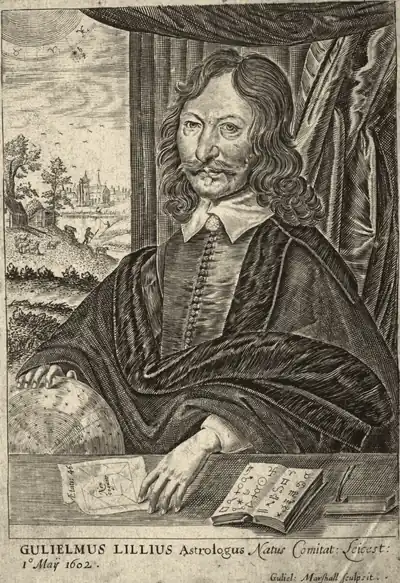
The text is Thomas Creech's 1697 verse translation, checked word by word between three scans of the same type (the 1697 printing, the 1700 printing and a third copy). The long s is printed as s; every other spelling is Creech's. Pages are cited as the 1697 printing numbers them. The portrait is William Marshall’s engraving of Lilly from the front of the 1659 printing (Wellcome Library, public domain).