The Twelve Signs of the Zodiack the chief Disposers of Fortunes
Creech's summary of Book III, then the twelve signs as the bosses of fortune.
[p. 95] The Argument
Manilius begins this Third Book as he did the Second, reckoning up and slighting the several Subjects which have imploy'd other Poets, and declaring his Design to be new and difficult; Then he proceeds to shew, 1. That the Twelve Signs of the Zodiack are the chief Disposers, and principal Governours of Fortunes. 2. That there are Twelve Lots belonging to these Twelve Signs. 3. He names and describes these Lots: The first is Fortune: The Second Warfare and Travelling: The Third, Civil Employments: The Fourth, Pleadings, and all the concerns of the Bar: The Fifth, Marriage Acquaintance, Guests: The Sixth, Plenty, Wealth, and the means of preserving it. The Seventh, Dangers: The Eighth, Nobility, Honour, Reputation: The Ninth, Children, Education. The Tenth, Manners, Institution, Family. The Eleventh, state of Health, Physick: The Twelfth, Wishes, and the ends of them. 4. He teaches how to suit these Lots, Labours, or Athla to the several Signs, when the Birth belongs either to Day, or Night. 5. He proposeth Rules how to find the Horoscope. 6. Refuting the Method prescrib'd by the Chaldaeans, 7. And shewing how to find the different lengths of Days and Nights, together with the several Risings and Settings of the Signs in order to find the Horoscope. 8. He resumes the Dispute against the Chaldaeans, and subjoins an Account of the several lengths of Days and Nights, in the three different Positions of the Sphere, Direct, Oblique, and Parallel. 9. He proposes another way to find the time of the Signs Rising and Setting. 10. He particularly Discourses of the Days Encrease from Capricorn to Cancer. 11. He shews what are the proper Years, Months, Days, and Hours of the Signs, and Confutes the Opinion of some Astrologers concerning them. 12. He sings how many Years belong to each Sign, and Station. 13. And Concludes the Book with an Account of the Tropick Signs.
[p. 96] I am not to Answer for the Astronomy, it is enough if I have made the Poet speak intelligible English.
[p. 97] Whilst I new ways attempt my groveling NameTo raise from Earth, and wing my Flight for Fame;Thro' Woods untrodden whilst I take my way,Ye Muses lead; for I extend your SwayTo larger Bounds, and make the World obey.
No Heaven's besieg'd, no Thunder thrown from farIntombs the Giants, and concludes the War:No fierce Achilles tells brave Hector's Spoil,Nor Priam bears the Hero to his Pile.No barbarous ¹Maid betrays her Father's trust,Nor tears her Brother to secure her Lust.No Bulls breath Fire, no Dragons guard the Prize;Nor from the poysnous seed Arm'd Harvests rise:No Youth returning here renews the Old,Nor treacherous Presents carry Flame in Gold,Nor will I sing the Babes Medea bore,Got by much Guilt, but ah! destroy'd by more.The Theban Siege, the highest Pride of Fame,Nor how the Town by Thunder sav'd from FlameLost whilst it ²conquer'd; nor how Spartans foughtRound old Messana, shall enlarge my thought.
No Sons ³and Brothers shall be joyn'd in one,Nor Mother bear a Granchild in a Son;No Murder'd Babes ⁴shall feast their injur'd Sire,Nor Days break off, and frighted Suns retire.None shall defy the Sea, the Floods enslave,Sail o're the Mountains⁵, and walk o're the Wave:No Asian Kings. And thee, O mighty Rome,Thy Arms, thy Conquests, and thy World o'recomeThy Laws, thy Wars, thy Leagues my Verse refuse,Those claim the leisure of a greater Muse.
[p. 98] Smooth Seas the Artless Sailer safely tries,And Flowers undress'd in fruitful Gardens rise;He works securely, who in Gold designs,When e'en the rude unpolisht Metal Shines;On specious Subjects common Wits compose,For where the Matter takes, the Fancy flows;And every vulgar Author writes with ease,Secure of Credit, where the Themes can please.This way some take to Fame: Thro' Words unknown,And things abstruse my Muse goes boldly on,Observes all Interchange of Times, comparesThe fatal turns, and views the Leagues of Stars,Things so remote, so intermixt, and wroughtWith Parts in Parts; they are too fine for thought.To know them is too much, but to explainHow great! to bind in Verse shews more than Man.
Then come, who e're thou art that bring'st a MindTo know high Truth, and patient Thoughts to find;Hear solid Reason, and go on to gainTrue serious Knowledge, but neglect the vain:No Kings at Aulis sworn, no tales of TroyWith Priam's tears, or Helen's fatal Joy,Nor hope sweet Verse, and curious turns to find,I'll leave thy Passions, and instruct thy Mind:And tho' some Words of foreign Stamp appear,Seem harsh, untun'd, uneasie to thy Ear;This is the Subject's not the Writer's fault,Some things are stiff, and will not yield to thought;I must be plain: And if our Art hath foundExpressions proper, it neglects the Sound.Thy Mind well purg'd from vainer Cares compose,For now my Muse is eager to disclose,The nicest Secrets; which observ'd, impartFate's Laws, and prove the surest Guides to Art.
[p. 99] When Nature order'd this vast Frame to rise,Nature, the Guardian of these Mysteries,And scatter'd Lucid Bodies o'er the Skies;When she the Concave, whence directly fallStreight Lines of Influence round the solid Ball,Had fill'd with Stars; and made Earth, Water, Air,And Fire, each other mutually repair;That Concord might these differing parts controul,And Leagues of mutual Aid support the whole;That nothing which the Skies embrace might beFrom Heaven's supreme Command and Guidance free,On Man the chiefest Object of her CaresLong time she thought, then hung his Fates on Stars;Those Stars, which plac'd i'th' Heart of Heaven, displayThe brightest Beams, and share the greatest sway;Which keep a constant Course, and now restrainThe Planets Power, now yield to them again;Thus sometimes ruling, sometimes rul'd, createThe strange and various Intercourse of Fate.
The notes
¹ This and the seven following Verses relate to the several particulars of Medea's story. (Creech’s note, 1697)
² I use this Interpretation rather than that of Scaliger and others, because I think Manilius speaks only of that famous Siege of Thebes, when the seven Generals attackt it; and as the Story says, Capaneus had almost ruin'd the Town before he was struck with Thunder. (Creech’s note, 1697)
³ Oedipus Married his own Mother Jocasta, and had Children by her; so that each Son was Brother to the Father, and Grand-Child to the Mother. (Creech’s note, 1697)
⁴ This respects the Story of Atreus and Thyestes. (Creech’s note, 1697)
⁵ Xerxes is said to have dug a Channel round Mount Athos, and to have made a Bridge over the Hellespont. (Creech’s note, 1697)
In the app the old words open a note in the margin when you tap them, the old books read the planets of your own chart, and each book opens where you left it. Free, no account, no email.
14160+ people cast their chart here in the last 30 days.
Keep reading
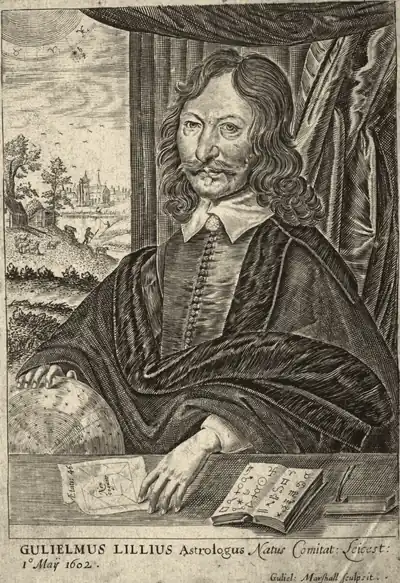
The text is Thomas Creech's 1697 verse translation, checked word by word between three scans of the same type (the 1697 printing, the 1700 printing and a third copy). The long s is printed as s; every other spelling is Creech's. Pages are cited as the 1697 printing numbers them. The portrait is William Marshall’s engraving of Lilly from the front of the 1659 printing (Wellcome Library, public domain).