Third Argument against the Chaldaeans
More against the Chaldeans: the days are not the same length everywhere.
[p. 110] Nor is o're all the Earth, the length of NightAnd Day the same; they vary with the sight;Nor, would the Ram alone and Scales agree,In Day and Night; in every Sign would beThe Equinox, if as these Rules devise,Two Hours were given to every Sign to rise.
The length of Days and Nights in a Direct Sphere
In that Position where Direct the Sphere,And in the Horizon both Poles appear;The Day maintains an equal length to Night,And that Usurps not on the others Right:No Inequality in Skies is found,But equal Day, and equal Night goes round.Those Days and Nights which Spring and Autumn bear,They see unvary'd thro' the rowling Year,Because the circling Sun in every SignRuns round, and measures still an equal Line;Whether thro' Cancer's height he bears the Day,Or thro' the Goat oppos'd He bends his way,The Day's alike, nor do the Nights decay.For tho' Oblique the Zodiack Circle lies,Yet all the Zones do at right Angles riseStill Parallel; and whilst the Sphere is RightHalf Heaven is Hid, and half expos'd to sight.
[p. 111] In an Oblique Sphere
Hence take thy way, and o're Earth's mighty BendFrom this midst Region move to either End,As weary Steps convey thee up the BallBy Nature rounded and hung midst the AllTo either Pole; whilst you your way pursueSome parts withdraw, and others rise to view.To you thus mounting as the Earth doth riseSo varies the Position of the Skies,And all the Signs that rose Direct beforeObliquely mount, and keep that Site no more;Oblique the Zodiack grows, for whilst we range,Tho fixt its place, yet ours we freely change;'Tis therefore plain that here the Days must proveOf different Lengths, since Signs obliquely move,Some nearer roul, whilst some remoter rove,And measure still unequal Rounds above;
On this side the Arctick Circle
As nearer to the Arctick Round you goThe Hours increase, and Day appears to grow;The Summer Signs in ample Arch invadeOur Sight, the Winter lie immerst in Shade;The more you Northward move, the more your EyesTheir Lustre lose; they set as soon as rise:
[p. 112] Beyond the Arctick Circle
But pass this Round, as you your way pursue,Each Sign withdraws with all its parts from view,Then Darkness comes, and chaces Light away,And thirty Nights excludes the Dawn of Day:Thus by degrees Day wasts, Signs cease to rise,For bellying Earth still rising up deniesTheir Light a Passage, and confines our Eyes.Continued Nights, continued Days appear,And Months no more fill up the rouling Year.
In an erect or parallel Sphere
Should Nature place us where the Northern SkiesCreak round the Pole, and grind the propping Ice,Midst Snows eternal, where th' impending BearCongeal'd leans forward on the frozen Air;The World would seem, if we survey'd the whole,Erect, and standing on the nether Pole.Its sides, as when a Top spins round, inclineNor here nor there, but keep an even Line,And there Six Signs of Twelve would fill the sight,And never setting at an equal Hight,Wheel with the Heavens, and spread a constant Light.And whilst thro' those the Sun directs his wayFor long Six Months with a continued RayHe chaces Darkness, and extends the Day.
But when the Sun below the Line descendsWith full Career, and to the lower bends,Then one long Night continued Darkness joins,And whilst he wanders thro' the Winter's SignsThe Arctick Circle lies immerst in Shade,And vainly calls to feeble Stars for Aid:Because the Eyes that from the Pole surveyThe bellying Globe, scarce measure half the way.The Orb still rising stops the Sight from far,And whilst we forward look, we find a Bar:For from the Eyes the Lines directly fall,And Lines direct can ne'er surround the Ball;Therefore the Sun to those low Signs confin'dBearing all Day and leaving Night behind,To those that from the Pole survey deniesHis chearful Face, and Darkness fills their Eyes;Till having spent as many Months, as pastThro' Signs, he turns, and riseth to the North at last:And thus, in this Position of the SphereOne only Day, one only Night appearOn either side the Line, and make the Year.
[p. 113] What different sorts of Days and Nights are knownIn all Positions thus my Muse hath shown;Her Work goes on, and she must next compriseWhat Signs appear, what Times they claim to riseIn all Positions of the moving Skies:That when you follow Art, and boldly pressTo find the Horoscope, a just SuccessMay meet thy search, and into knowledge raise thy guess.But who can all their various times reherse?Compute so much, and state Accounts in Verse?Therefore this part let general Rules define,Let those that follow my advanc'd DesignApply them right, but let the Rules be mine.
In the app the old words open a note in the margin when you tap them, the old books read the planets of your own chart, and each book opens where you left it. Free, no account, no email.
14160+ people cast their chart here in the last 30 days.
Keep reading
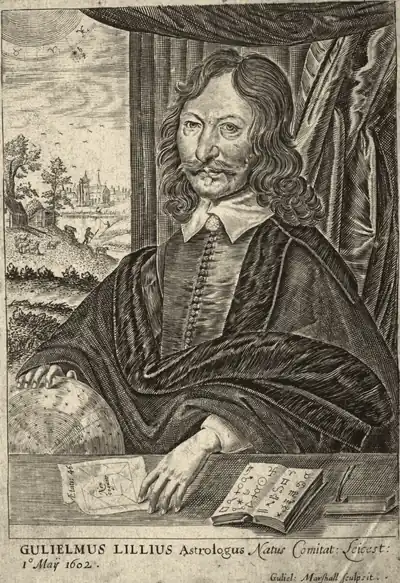
The text is Thomas Creech's 1697 verse translation, checked word by word between three scans of the same type (the 1697 printing, the 1700 printing and a third copy). The long s is printed as s; every other spelling is Creech's. Pages are cited as the 1697 printing numbers them. The portrait is William Marshall’s engraving of Lilly from the front of the 1659 printing (Wellcome Library, public domain).