Another way to find the Signs Rising and Setting by Hours
Another way to find which signs rise and set, hour by hour.
[p. 114] Where-ever plac'd, by these few Rules proceed,By Nature settled, and by Art decreed;First count how many ²¹Hours compleat the Night,Or Day, when Cancer in the Summer's heightBears Phoebus, and short darkness bounds the light,Day's Hours by Six divide, one sixth deviseTo following Leo as his time to rise:Night so divided too one Sixth bestowOn Taurus, that his rising time will show:But then observe the difference of the timeWhich Leo takes, and which the Bull to climb,That into Three divide, and thence apply,Beside the time which Taurus takes to mount the Sky,One single Third to Naked Gemini.The like to Cancer, and the like AccountTo fiery Leo as his time to mount;Then reckon all, you'll find the Sum the sameWhich from the first Division to Leo came,When one sixth part of Day was given to raise his Flame.
[p. 132] A figure or table stood here (Creech's Scheme to note 21 (rising times of the Signs by this method); not readable in any scan). It did not survive the scan, so it is not reprinted.
[p. 114] By the same Method Virgo's time define:But this Condition runs thro' every Sign,The following keeps those Hours the Sign beforeObtain'd to rise, and vulgarly adds more:As these an orderly Encrease maintain,So Signs from Libra still decrease again;But different Order they observe in Skies,The Hours these claim to Set, those take to Rise.
By Stadia
But if you count by Stadia, change the Name,But keep the Method, for the Rule's the same:Seven Hundred Twenty Stadia fill the Round,No more in Day, no more in Night are found:Hence take as many as compleat the Night,When glowing Cancer in the Summer's hightBears Phoebus, and short darkness bounds the light.The rest by Six divide, one Sixth deviseTo fiery Leo as his time to rise;Night's Stadia so divide, one Sixth bestowOn Taurus: Take the Difference twixt the Two,That Sum divide by Three, and thence apply,Beside the Stadia Taurus takes to mount the Sky,One single Third to naked Gemini.
[p. 115] Thus to the rest proceed, but still confineTo following Signs the Stadia of the former Sign,With one Third Part's Encrease; till Libra's RayThis Reckoning stops, and shews another way:For Signs from Libra different Rules comprise,A different Order they observe in Skies,The Stadia others claim, to Set they take to Rise.Those Stadia too in which the rest ascendThese Winter Signs in slowly setting spend.
Thus having fixt the Stadia, now pursueThe Horoscope, 'tis open to thy view;From that Degree in which the Sun doth mountObserve my Method, and begin to count;Give proper Hours to every Sign to rise,And proper Stadia to ascend the Skies,Work by those Rules which I have shewn before,Securely work, for you can err no more.
The notes
²¹ Let the longest Day in Cancer be of 16 Hours, the shortest Night of 8: Divide those 16 Hours into 6 parts, each part contains 2 Hours 40 Minutes: Therefore allow Leo 2 Hours 40 Min. for his Rising time: Divide likewise the 8 Hours of Night into 6 parts, each part will contain 1 Hour 20. m. and that is the rising time of Taurus. The Difference between the Rising Times of these two Signs is 1 Hour 20 Min. Divide this Difference into three equal parts, each part will contain 26 Min. 40 Sec. Add these 26 Min. and 40 Sec. to the Rising time of Taurus, and the whole Sum makes up the Rising time of Gemini, viz, 1 Hour, 46 Min. 40 Sec. To this add another third part to make up the Rising time of Cancer, viz. 2 Hours 13 Min. 20 Sec. And so of the rest, as in the following Scheme.
But it must always be observed, that the Southern or Winter Signs are oppos'd to the Northern or Summer Signs. The Rising-time of the Summer is the Setting-time of the Winter; and the Setting-time of the Summer the Rising-time of the Winter Signs. (Creech’s note, 1697)
In the app the old words open a note in the margin when you tap them, the old books read the planets of your own chart, and each book opens where you left it. Free, no account, no email.
14160+ people cast their chart here in the last 30 days.
Keep reading
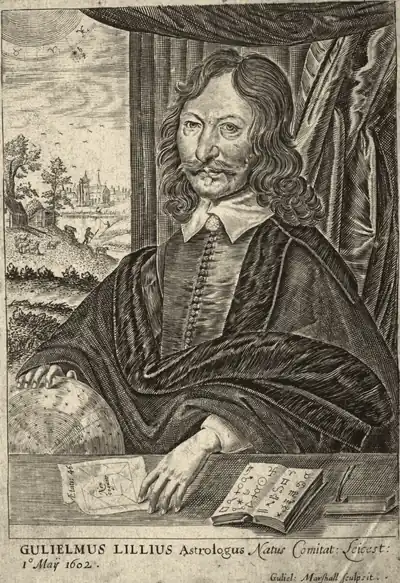
The text is Thomas Creech's 1697 verse translation, checked word by word between three scans of the same type (the 1697 printing, the 1700 printing and a third copy). The long s is printed as s; every other spelling is Creech's. Pages are cited as the 1697 printing numbers them. The portrait is William Marshall’s engraving of Lilly from the front of the 1659 printing (Wellcome Library, public domain).