The Arrow
The Arrow: archers, and anyone who never misses.
[p. 66] What Constellations rise with Libra
Now Southward bend, and see in Southern SkiesWith Libra's Eighth Degree the Arrow rise:Their Beams are strong: They curious Arts bestow,To dart the Javelin, and to draw the Bow;Or sling the Bullet; from the lofty CloudsSwift Birds shall drop, nor shall the deepest FloodsSecure their Fish: But both shall surely feelThe fatal force of the unerring Steel;What powerful Stars but these drew here belowBrave ²¹Philoctete's and sure ²²Teucer's Bow?One Hector's Flames repell'd, the angry FireDid fear his Shafts, and sullenly retire;The other bore Troy's Fate, more dreadful far,He sate Exil'd, than all the Greeks in War.
He own'd those Stars, ²³who when the Serpent layTwin'd round his Child, and Sucks the Bleeding Prey;Ventur'd to shoot: The pious Arrow fledAs sent by Fate, and pierc'd the Dragon's Head:To be a Father then was Art, and LoveBy Stars unaided, had but vainly strove;They drew the Bow, restor'd the flying BreathTo the lost Boy, and wak'd the Youth from Death.
The notes
²¹ Philoctetes was Servant to Hercules, and when Hercules burnt himself, he left his Bow and Arrows to Philoctetes; Without these Arrows Troy could not be taken; Now it happened that Philoctetes, either by a contrivance of Ulysses, or because, being wounded by one of the Poisoned Arrows, he became offensive to the Grecian Camp, was sent away to Lemnos: But the Siege going on slowly, he was fetcht back again: With his Arrows he killed the chiefest of the Remaining Commanders, and so Troy was taken. (Creech’s note, 1697)
²² Teucer was Brother to Ajax, and he with his Bow beat back Hector when he came to burn the Grecian Navy. (Creech’s note, 1697)
²³ The following Verses relate to Alcon the Cretan, who shot a Snake that lay twisted round the Head of his Son, and did not touch the Boy. (Creech’s note, 1697)
In the app the old words open a note in the margin when you tap them, the old books read the planets of your own chart, and each book opens where you left it. Free, no account, no email.
14160+ people cast their chart here in the last 30 days.
Keep reading
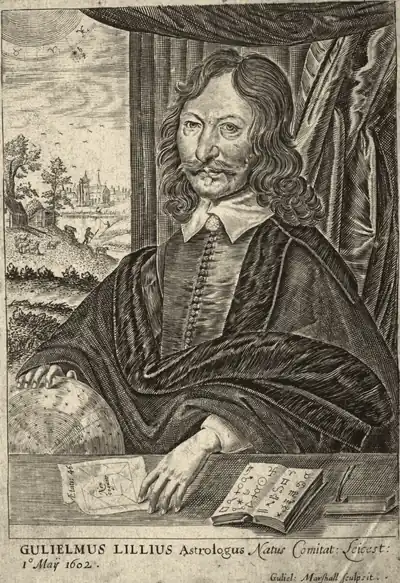
The text is Thomas Creech's 1697 verse translation, checked word by word between three scans of the same type (the 1697 printing, the 1700 printing and a third copy). The long s is printed as s; every other spelling is Creech's. Pages are cited as the 1697 printing numbers them. The portrait is William Marshall’s engraving of Lilly from the front of the 1659 printing (Wellcome Library, public domain).