Constellations North of the Zodiac
The constellations north of the zodiac, and which planets they behave like.
[p. 28] The constellations north of the zodiac have their respective influences, analogous to those of the planets, existing in the mode described in the following list.
| Ursa Minor. | The bright stars in this constellation are like Saturn, and in some degree like Venus. |
|---|---|
| Ursa Major | is like Mars, but the nebula under the tail resembles the Moon and Venus in its influence. |
| Draco | The bright stars operate like Saturn and Mars. |
| Cepheus | is like Saturn and Jupiter. |
| Bootes | is like Mercury and Saturn; but the bright and ruddy star, called Arcturus, is like Mars and Jupiter. |
| Corona Borealis | is like Venus and Mercury. |
| Hercules (or the Kneeler) | is like Mercury. |
| Lyra | is like Venus and Mercury. |
| Cygnus | Venus and Mercury. |
| Cassiopeia | Saturn and Venus. |
| Perseus | Jupiter and Saturn: but the nebula, in the hilt of the sword, is like Mars and Mercury. |
| Auriga | The bright stars are like Mars and Mercury. |
| Serpentarius | is like Saturn, and moderately like Venus. |
| Serpens | is like Saturn and Mars. |
| Sagitta | Saturn, and moderately like Venus. |
| Aquila | is like Mars and Jupiter. |
| Delphinus | Saturn and Mars. |
| Equus (or Pegasus) | The bright stars are like Mars and Mercury. |
| Andromeda | is like Venus. |
| Delta (or the Triangle) | Mercury. |
In the app the old words open a note in the margin when you tap them, the old books read the planets of your own chart, and each book opens where you left it. Free, no account, no email.
14160+ people cast their chart here in the last 30 days.
Keep reading
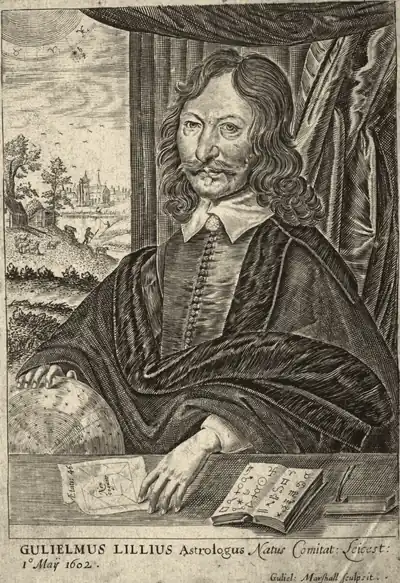
The text is J. M. Ashmand's 1822 translation, checked word by word between two scans of the 1822 printing (Wellcome Library and Harvard). Pages are cited as the 1822 printing numbers them. The portrait is William Marshall’s engraving of Lilly from the front of the 1659 printing (Wellcome Library, public domain).