Constellations South of the Zodiac
The constellations south of the zodiac, the same treatment.
[p. 30] The influences of the constellations south of the zodiac, existing in a similar mode, are as follow:—
| Piscis Australis | The bright star in the mouth is of the same influence as Venus and Mercury. |
|---|---|
| Cetus | is like Saturn. |
| Orion | The stars on the shoulders operate similarly to Mars and Mercury; and the other bright stars to Jupiter and Saturn. |
| Fluvius, or Eridanus. | The last bright one is of the same influence as Jupiter; the rest are like Saturn. |
| Lepus | is like Saturn and Mercury. |
| Canis | The bright star in the mouth is like Jupiter, and partly like Mars: the others are like Venus. |
| Procyon* | The bright star is like Mercury, and in some degree like Mars. |
| Hydrus | The bright stars are like Saturn and Venus. |
| Crater | is like Venus, and in some degree like Mercury. |
| Corvus | is like Mars and Saturn. |
| Argo | The bright stars are like Saturn and Jupiter. |
| Centaurus | The stars in the human part of the figure are of the same influence as Venus and Mercury: the bright stars in the horse’s part are like Venus and Jupiter. |
| Lupus | The bright stars are like Saturn, and partly like Mars. |
| Ara | is like Venus, and also Mercury in some degree. |
| Corona Australis | The bright stars are like Saturn and Jupiter. |
[p. 31] The respective influences of the several stars have been observed by the antients to operate in conformity with the mode pointed out in the foregoing distributions*.
The notes
* Canis Minor. (Ashmand’s note, 1822)
* “Of the fixed stars in general,” Whalley says, “those of the greatest magnitude are the most efficacious; and those in, or near, the ecliptic, more powerful than those more remote from it. They with north latitude and declination affect us most. They in the zenith, influence more than others, more remote. Likewise such as are in partile conjunction with, or in the antiscions of any planet, or which rise and set, or culminate with any planet, or are beheld by any planet, have an increase of power: but of themselves the fixed stars emit no rays.” (a note, p. 31)
In the app the old words open a note in the margin when you tap them, the old books read the planets of your own chart, and each book opens where you left it. Free, no account, no email.
14160+ people cast their chart here in the last 30 days.
Keep reading
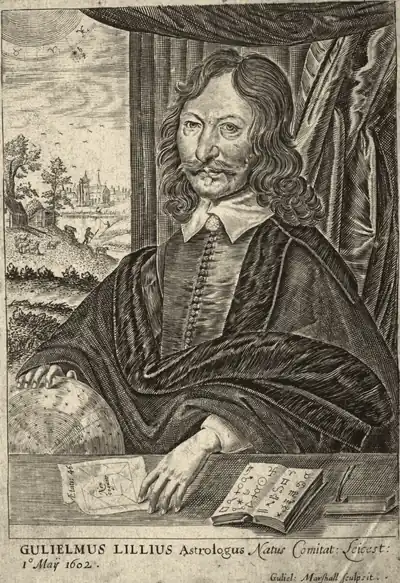
The text is J. M. Ashmand's 1822 translation, checked word by word between two scans of the 1822 printing (Wellcome Library and Harvard). Pages are cited as the 1822 printing numbers them. The portrait is William Marshall’s engraving of Lilly from the front of the 1659 printing (Wellcome Library, public domain).