The Annual Seasons
Spring, summer, autumn and winter, as the four moods of the year.
[p. 31] The year comprises four seasons; spring, summer, autumn, and winter: of these, the spring partakes chiefly of moisture, for on the dissipation of cold and recommencement of warmth, an expansion of the fluids takes place: the summer is principally hot, owing to the Sun’s nearest approach to the zenith: the autumn is principally dry, because the recent heat has absorbed the moisture: and the winter is chiefly cold, the Sun being then at his farthest distance from the zenith.
The beginning of the whole zodiacal circle, (which in its nature as a circle can have no other beginning, nor end, capable of being determined,) is therefore assumed to be the sign of Aries, which commences at the vernal equinox*: since the moisture of spring forms a primary beginning in the zodiac, analogous to the beginning of all animal life; which, in its first age of existence, abounds principally in moisture: the spring too, like the first age of animal life, is soft and tender; it is therefore suitably placed as the opening of the year, and is followed by the other seasons in appropriate succession. The summer comes second, and, in its vigour and heat, agrees with the second age of animals; the prime of life, and the period most abounding in heat. Again, the age when the prime of life has passed away, and in which decay prepares to advance, is chiefly abundant in dryness, and corresponds to the autumn. And the final period of old age, hastening to dissolution, is principally cold, like the winter.
The notes
* This sentence shews the futility of the objection raised against astrology (and mentioned in the Preface to this translation) that the signs have changed and are changing places. It is clear from this sentence that Ptolemy ascribes to the 30 degrees after the vernal equinox, that influence which he has herein mentioned to belong to Aries; to the next 30 degrees, the influence herein said to belong to Taurus; and so of the rest of the zodiac. We should rather say that the stars have changed places, than that the parts of heaven, in which they were once situated, have done so. Ptolemy himself seems to have foreseen this groundless objection of the moderns, and has written, in the 25th chapter of this book, what ought completely to have prevented it. It has certainly been one of the misfortunes of astrology to be attacked by people entirely ignorant of its principles. (Ashmand’s note, 1822)
In the app the old words open a note in the margin when you tap them, the old books read the planets of your own chart, and each book opens where you left it. Free, no account, no email.
14160+ people cast their chart here in the last 30 days.
Keep reading
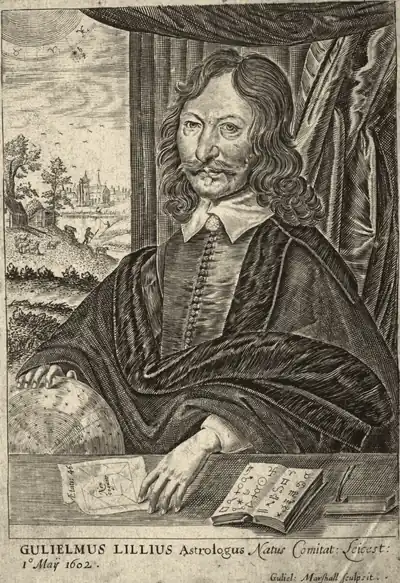
The text is J. M. Ashmand's 1822 translation, checked word by word between two scans of the 1822 printing (Wellcome Library and Harvard). Pages are cited as the 1822 printing numbers them. The portrait is William Marshall’s engraving of Lilly from the front of the 1659 printing (Wellcome Library, public domain).