The Influence of Position with regard to the Sun
What a planet does when it rises before the Sun, or after it.
[p. 23] The respective powers of the Moon and of the three superior planets are either augmented or diminished by their several positions with regard to the Sun.
The Moon, during her increase, from her first emerging to her first quarter, produces chiefly moisture: on continuing her increase from her first quarter to her full state of illumination, she causes heat; from her full state to her third quarter she causes dryness; and from her third quarter to her occultation she causes cold.
The planets, when matutine, and from their first emerging until they arrive at their first station, are chiefly productive of moisture; from their first station until they rise at night, of heat; from their rising at night until their second station, of dryness; and from their second station until their occultation, they produce cold*.
[p. 24] But it is also sufficiently plain that they must likewise cause, by their intermixture with each other, many varieties of quality in the Ambient: because, although their individual and peculiar influence may for the most part prevail, it will still be more or less varied by the power of the other heavenly bodies configurated with them.
The notes
* Although all the positions mentioned in this paragraph are not applicable to Venus and Mercury, which can never rise at night, that is to say, at sunset, and although the author in the beginning of the chapter speaks only of the Moon and the three superior planets, there yet seems no reason why the orbits of Venus and Mercury should not be similarly divided by their inferior and superior conjunctions, and their greatest elongations.
The following is from Whalley: “The first station, in this chapter mentioned, is when a planet begins to be retrograde; and the second station when, from retrogradation, a planet becomes direct. They” (the planets) “begin to rise at night when in opposition to the Sun.” (Ashmand’s note, 1822)
In the app the old words open a note in the margin when you tap them, the old books read the planets of your own chart, and each book opens where you left it. Free, no account, no email.
14160+ people cast their chart here in the last 30 days.
Keep reading
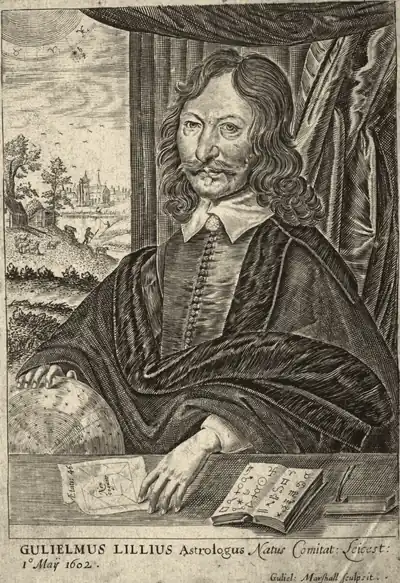
The text is J. M. Ashmand's 1822 translation, checked word by word between two scans of the 1822 printing (Wellcome Library and Harvard). Pages are cited as the 1822 printing numbers them. The portrait is William Marshall’s engraving of Lilly from the front of the 1659 printing (Wellcome Library, public domain).