Diurnal and Nocturnal
Day planets and night planets. The sky had a shift rota.
[p. 22] The day and the night are the visible divisions of time. The day, in its heat and its aptitude for action, is masculine:—the night, in its moisture and its appropriation to rest, feminine.
Hence, again, the Moon and Venus are esteemed to be nocturnal; the Sun and Jupiter, diurnal; and Mercury, common; since in his matutine position he is diurnal, but nocturnal when vespertine.
Of the other two planets, Saturn and Mars, which are noxious, one is considered to be diurnal, and the other nocturnal. Neither of them, however, is allotted to that division of time with which its nature accords, (as heat accords with heat), but each is disposed of on a contrary principle: and for this reason, that, although the benefit is increased when a favourable temperament receives an addition of its own nature, yet, the evil arising from a pernicious influence is much mitigated when dissimilar qualities are mingled with that influence. Hence the coldness of Saturn is allotted to the day, to counterbalance its heat; and the dryness of Mars to the night, to counterbalance its moisture. Thus each of these planets, being moderated by this combination, is placed in a condition calculated to produce a favourable temperament*.
The notes
* Whalley here appends the following note: “To this chapter may be properly added, that a planet is said to be diurnal, when, in a diurnal nativity, above the earth; and, in a nocturnal nativity, under the earth: but nocturnal, when, in a nocturnal nativity, above the earth; or, in a diurnal nativity, under the earth.” (a note, p. 23)
Old words on this page
- diurnal
- of the day. A diurnal planet or sign belongs to daytime.
- nocturnal
- of the night. A nocturnal planet or sign belongs to night-time.
In the app the old words open a note in the margin when you tap them, the old books read the planets of your own chart, and each book opens where you left it. Free, no account, no email.
14160+ people cast their chart here in the last 30 days.
Keep reading
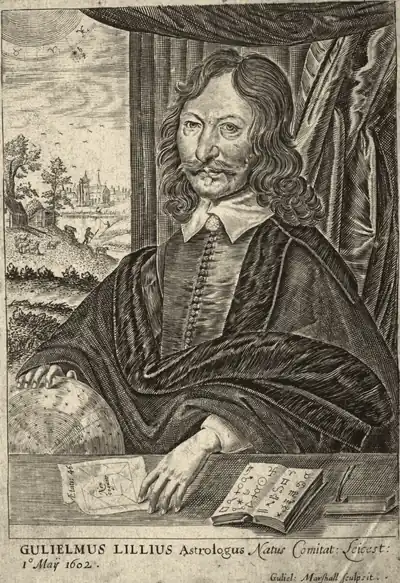
The text is J. M. Ashmand's 1822 translation, checked word by word between two scans of the 1822 printing (Wellcome Library and Harvard). Pages are cited as the 1822 printing numbers them. The portrait is William Marshall’s engraving of Lilly from the front of the 1659 printing (Wellcome Library, public domain).