

☽ Free Moon Sign Calculator
Umbriel's free Moon sign calculator finds your natal Moon's sign and exact degree from your birth date, time and place.
Runs in your browser.
4420+ people cast their chart here in the last 30 days.
No account, no email. The Moon is the fastest-moving body in the chart, twelve to fifteen degrees a day, which is why it can be in one sign at breakfast and the next by bedtime on the day you were born.
- What you'll needBirth date, time and place
- What you getYour Moon's sign and exact degree, the house it falls in, its phase at birth, and every aspect it makes
- CostFree, no account required
What a Moon sign is
Your Moon sign is the zodiac sign the Moon occupied at the moment you were born. Where the Sun sign is the one everybody knows, the Moon is traditionally associated with the inner weather: emotional habits, what settles you, what you reach for when nobody is watching. Older texts tie it to the mother, the body and the night, the parts of a life that are felt, not declared.
It moves fast. The Moon crosses a sign in roughly two and a half days, so on a sizeable minority of days it changes sign partway through, and a chart cast for the wrong hour can hand you the wrong sign entirely. That is the whole reason a calculator beats a table: your time, in your birth city's zone, with the daylight saving that was in force that year.
Two things worth knowing before you read whatever comes back. The Moon's house often says more than its sign about where the feeling lands, and the Moon's aspects (especially to Saturn, Venus and the Sun) describe how easily it moves. A sign on its own is a headline. And none of it is a verdict. It is a prompt, and you are allowed to disagree with it.
How Umbriel computes it
This tool finds the zodiac sign and exact degree of the Moon at your birth moment. Umbriel converts your local birth time to UTC using the IANA time-zone database, which includes historical daylight saving, then computes the Moon's apparent ecliptic longitude for that instant from a truncated ELP-2000/82 series, corrected for nutation. The sign is the longitude divided by 30 degrees, and the degree and minute are the remainder. The tropical zodiac is the default; on a sidereal chart the selected ayanamsa is subtracted from the longitude before the sign is taken, so the same Moon can fall in a different sign under the two conventions. The house the Moon falls in comes from the Ascendant and cusps, so it needs your birth time and the house system chosen, while the sign itself needs only the moment. Against NASA/JPL Horizons the Moon is within 0.27 arcminutes across 1600 to 2050, which is small next to a sign of 1,800 arcminutes. The real uncertainty is your birth time: the Moon moves about half a degree an hour, so a time several hours out can change the sign when the Moon is near a sign boundary. Reading a Moon sign as temperament is a symbolic tradition laid over the measured position.
What's in your result
- Sign and exact degreeNot just 'Scorpio'. The degree and minute, so you can see how close it sits to the edge of a sign.
- The house it falls inWhere the Moon's business tends to show up in a life: home, work, partnership, the private fourth. Needs your birth time.
- Its phase at birthThe Moon's relationship to the Sun on your birthday (new, crescent, full, balsamic) read as its own placement.
- Every aspect it makesEach contact to the Moon, with its exact orb, and whether it was applying or separating at the time.
- Whether it was void of courseThe stretch after the Moon's last aspect in a sign, traditionally read as a lull. Most calculators never mention it.
- The sign's rulerWhere the Moon's dispositor sits: the placement the whole Moon story reports to.
Don’t know your birth time?
Know it roughly? Give the time and say where it came from (a certificate, a parent’s memory, or something rough like “early morning”), and your chart tells you what could change within that window.
Don’t know it at all? Umbriel does not fill the gap with a guess. Tick “I don’t know the time at all” and it checks your whole birthday, hour by hour, then tells you two things: which placements are the same whatever time you were born, as exact as they would be if you knew the minute, and which are down to two signs, both named, so you know what a parent’s memory would settle.
The Ascendant, the Midheaven and the houses are left out rather than approximated. A birth time is the one thing they cannot be computed without, and an approximate Rising sign that looks exact is worse than no Rising sign at all.
What this calculator answers
Which sign the Moon was in at your birth, to the degree and minute.
How it calculates
Umbriel turns your birth time into UTC, then works out the Moon's position for that moment from a shortened version of the ELP-2000/82 lunar theory, corrected for nutation. The sign is the Moon's longitude divided by 30. Signs are tropical unless you chose sidereal.
When the result is uncertain
The Moon moves about half a degree an hour, so a birth time several hours out can change the sign when it sits near an edge. The sign needs only the moment of birth; the house the Moon falls in also needs your exact time and place.
Common questions
Can I find my Moon sign without a birth time?
Usually, yes, though not always. Leave the time blank and it casts for noon, shows the Sun, Moon and planets, and skips the Ascendant and houses rather than inventing them. The catch is the Moon itself: if it changed sign on your birthday, noon can land on the wrong side of the switch. If the degree comes back very early or very late in a sign, that is the case where the time genuinely matters.
What is a Moon sign supposed to mean?
It is traditionally associated with emotional temperament: what you need in order to feel settled, how you react before you have thought about it, what comforts you. Best held as a description of a tendency you might recognise, not a rule about who you are.
Why do two websites give me different Moon signs?
Nearly always the time zone. A birth chart has to use the zone of the birth city on the birth date, including whatever daylight-saving rule was in force that year, which has changed more often than people expect. Umbriel sets the zone from your birth place, not from your phone. The other cause is a genuine sign change on the day itself.
What is the difference between my Sun sign and my Moon sign?
The Sun is the sign the Sun was in: the one horoscopes are written for. The Moon is a separate placement entirely, and many people find it describes their private life far better than the Sun does.
Is this Moon sign calculator free?
Yes: sign, degree, house, phase and aspects, with no account and no email.
What if I don’t know my birth time?
Umbriel checks your whole birthday hour by hour and separates what is certain from what is not. Placements that are the same whatever time you were born are shown as exact. Placements that changed sign during the day are shown as two named signs, so you know what a parent's memory would settle. The Ascendant, Midheaven and houses are left out rather than approximated. They cannot be computed without a time, and an approximate Rising sign that looks exact is worse than none.
Do I need an account or an email address?
No. There is no sign-up, no email capture and no free trial. Enter your details and the result is drawn in your own browser.
Go deeper
Every one of these is a page in its own right, written out one at a time.
Related free tools
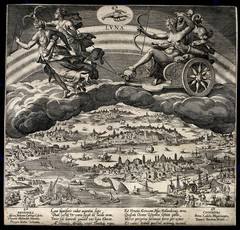
Prints in the head of this page, all public domain except where stated: The Moon, from The Seven Planets, Jan Sadeler I, 1585, Art Institute of Chicago; Diana (Artemis) riding the chariot of the moon across the heavens. Engraving by J. Sadeler after M. de Vos., Wellcome Collection; Urania's Mirror, Sidney Hall, 1825, Library of Congress via Wikimedia Commons. Ground: Andreas Cellarius, Harmonia Macrocosmica, 1661, Wikimedia Commons.
Umbriel offers every system here as a set of prompts to think with, never as a statement of fact about who you are. Take what's useful, leave the rest.