The Whale
The Whale: the monster again, and fishers with nets.
[p. 80] … 'd to our viewThe Whale, who now doth thro the Skies pursueWith eager haste, as thro' the injur'd FloodThe fair Andromeda, and still thirsts for Blood.And He that then is born shall be inclin'dTo spoil the Sea, and kill the Scaly Kind,No Fish shall swim secure whilst Nets can sweepThe troubled Ocean, and confine the Deep:Those that but now could wanton or'e the MainShall lye fast bound, and wonder at their chain;Till with a touch He shall the Cords command,And draw the Dancing Captives to the Land.
[p. 81] Or whilst He shoals expects e'en midst the FloodDestroy, and stain the Ocean with their Blood.Yet then his works not cease, or pains decay,His various Arts encreasing with his prey:For on the Shore He shall his spoil divideFor different uses. This when lightly dry'dIs better Meat; and that when moist is good,Whilst other parts are hardned into Food.Could Gluttons see, they would not bear the sightOf preparations for their Appetite,Whilst Blood and Guts in a polluted MassLye mixt, and are corrupted into Sauce;Till all in filthy Gore distils to treatThe fashionable Palate of the Great.
Or if to meaner Arts his Thoughts encline,Then Salt's his care; he shall the Floods confineIn narrow Pitts, and to the Beams expose,Till what was liquid now a solid grows,Then lay the crusted froth with careful handIn heaps, and cleanse it, and divide the Sand.And thus the brackish and unwholesom FloodProves vital Salt, and Poyson's turn'd to Food.
In the app the old words open a note in the margin when you tap them, the old books read the planets of your own chart, and each book opens where you left it. Free, no account, no email.
14160+ people cast their chart here in the last 30 days.
Keep reading
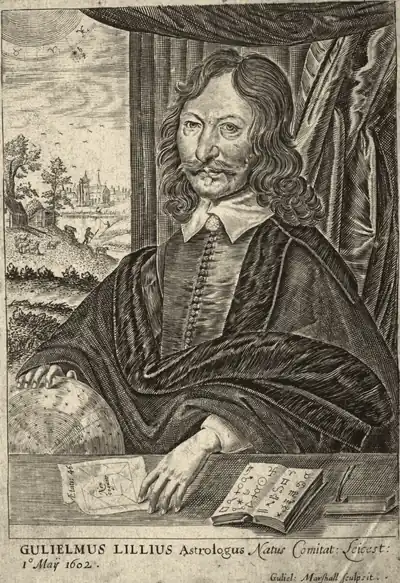
The text is Thomas Creech's 1697 verse translation, checked word by word between three scans of the same type (the 1697 printing, the 1700 printing and a third copy). The long s is printed as s; every other spelling is Creech's. Pages are cited as the 1697 printing numbers them. The portrait is William Marshall’s engraving of Lilly from the front of the 1659 printing (Wellcome Library, public domain).